Plate goes in at one end and a hull leaves at the other.
Every station between them is a queue.
Can the yard build this vessel on its own cells and crews?
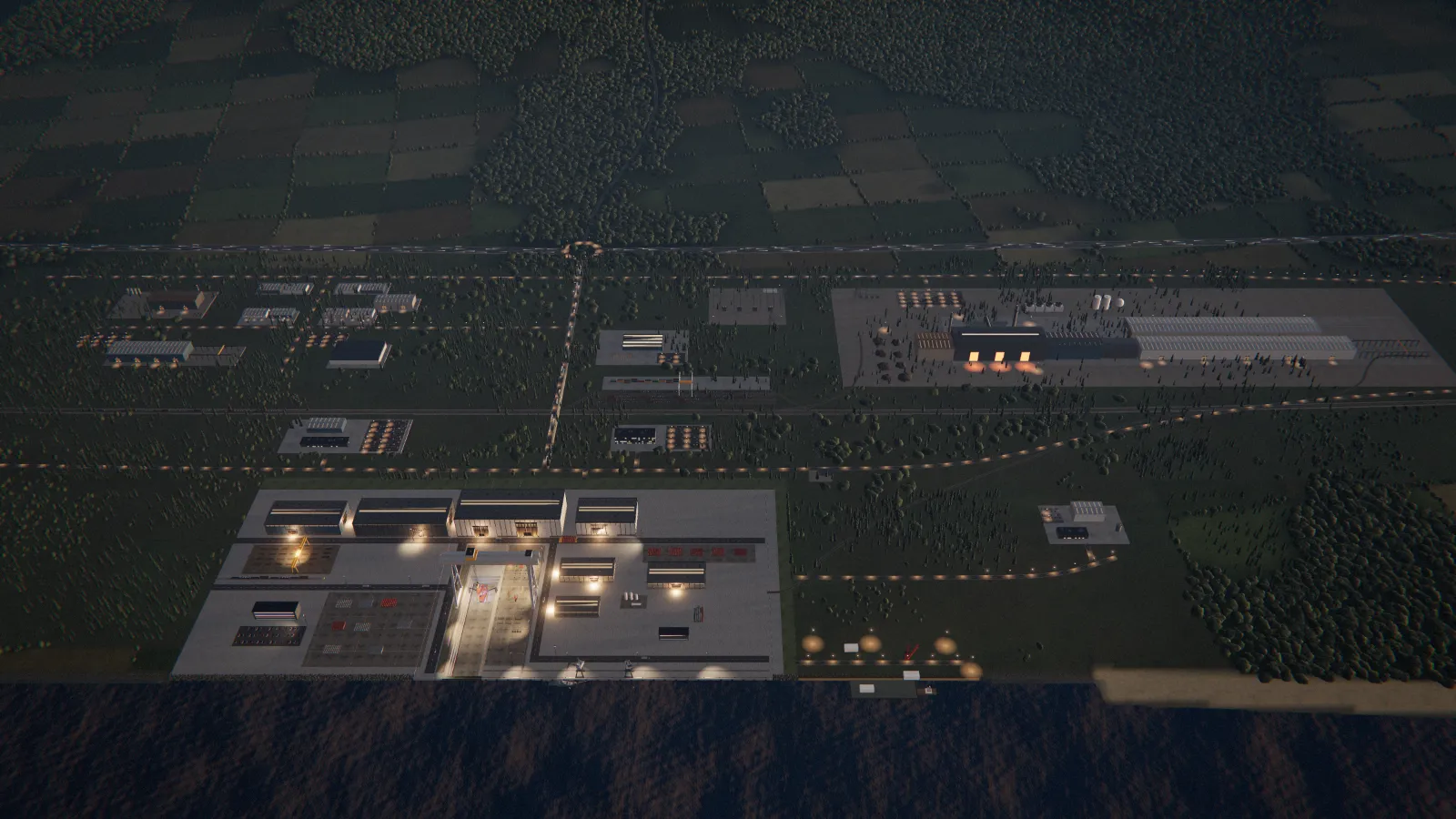
Concept visualization. A yard among the mill, shops, rail, power and port it depends on. Synthetic model; not a Veldarium facility.
To build more ships, America has to find the station that sets the pace and relieve it. Cutting table, panel line, block hall, crane: each is finite, and each needs people qualified to its procedures. The first to run out binds, and the whole line delivers no faster than it does. That is why Veldarium starts from the whole chain, not one dashboard inside it.
Synthetic model on a concept vessel. Veldarium operates no yard, cell, crew or machine, and measures no rate, uptime or yield.
Same blocks, same sequence, same work content. Why does the finite yard finish 3 days later?
Unlimited, the sprint takes 35 days. On this yard it takes 38.
Nothing about the work changed: three blocks need the panel line and the yard has one, so they wait their turn and every successor waits behind them.
The same sprint on unlimited and on finite capacity
From cut plate to system test, on 3 of VS-001's 7 schematic blocks. No launch or harbor test: those need the whole hull.
Same 21 activitiesSame dependenciesOnly the cells and crews differ
35daysif every cell and crew were unlimited
38dayson this yard's finite capacity
+3 days of queue, set by the panel line. The 42-day target is met with 4 days to spare.
Why that station binds, and what moves it
Effective capacity is nameplate (staffed hours × qualified rate) × availability × first-pass yield. On the most loaded class, 78 of every 100 nameplate units survive as capacity a program can schedule against.
Scroll to take the line apart, one factor at a time.
01 Demand What the program asks of each stage in the window: 100 on every channel, in its own unit.
02 Nameplate Staffed hours × qualified rate. On paper, every stage has room.
03 Availability Setup, calibration, maintenance and faults take their share of the staffed time.
04 First pass Work that fails first time comes back and uses the channel twice.
05 Narrowest What is left is executable. The line can carry no more than its narrowest channel: panel line weld. Every channel is above the ask, so output stays at the ask.
06 Queue A ranking term, ρ ÷ (1 − ρ): as a stage nears full it climbs steeply. It ranks stages; it does not measure waiting.
07 Relief Half the downtime and setup recovered at the narrowest stage, on the hours it already has. The line could carry 4 points more (headroom, not output), and the constraint moves to structural weld (robotic + manual).Half the downtime and setup recovered at the narrowest stage; the constraint moves to structural weld (robotic + manual).
08 Schedule The resource-constrained schedule forecasts 38 days against a 42-day target (met); its binding resource is the panel line.38 days forecast against a 42-day target.
Stress the line: delays, downtime, rework, and what each intervention moves
BaselineThe planned sprint: every class staffed and qualified, no fault, demand as scoped.
Executable capacity, stage by stage
111%of the program the line can carry · limited by panel line weld
The line could carry 111% of what the program asks, set by panel line weld, its shortest stage. Above 100, output stays at what the program asks; capacity above the line’s level, at every stage, is real and the line cannot use it.
Panel line weld most loaded
2,352 weld-meters on the equipment list. 1,832 the program can schedule against.
- 100Nameplate
availability82%−18 index · −423 weld-metersThe cell exists and is staffed, and is not producing: setup, calibration, maintenance, faults.
82Availablefirst-pass yield95%−4 index · −96 weld-metersWork happened and was not accepted first time. The rework consumes the capacity twice.
78Executable
Indexed to 100 for this class only. The six classes are measured in weld-meters and four other units, so they are never summed: a total across plate parts and block lifts has no referent.
What changes panel line weld
- Largest loss
- Availability. Most of what is lost below nameplate is downtime and setup: the capacity exists and is not producing. Uptime recovered and hours added raise capacity in the same proportion; which costs less is outside the model. 423 to downtime · 96 to rework, in weld-meters
- Candidate lever
- Recover uptime on the panel line weld: setup reduction and planned maintenance. Winning back half of the downtime and setup takes availability from 82% to 91%: 201 more weld-meters of capacity in the window, on hours the class already has. Nothing has to be added to meet demand: the panel line weld already covers it with 182 weld-meters to spare, and the recovery widens that to 383. It buys headroom, not output.
- Before it is capacity
- Recovered uptime counts only once the panel line weld's downtime and setup records show it held over a sustained window; a plan is an intention, not uptime.
- Qualification
- qualified · internal · 1 qualified cell · governing evidence: Weld procedure specification (WPS) and procedure qualification record (PQR).
- Downstream
- The resource-constrained schedule forecasts 38 days against a 42-day target (met); its binding resource is the panel line.
And which of it may start
Capacity that may not start is not slow capacity; it is none. Release a change, lapse a calibration or withdraw a qualified person, and watch which cells stop.
synthetic · 8 cells × 14 gates
And which of it may start
Capacity that may not start is not slow capacity; it is none. Release a change, lapse a calibration or withdraw a qualified person, and watch which cells stop.
Which of these cells may execute this work right now?
The yard at rest is not uniformly green. Two cells cannot establish their own authorization, because the machine in them carries no calibration record at all. That is an unknown, not a pass.
- May execute14/14
CUT-02 Plasma cutting cell
Steel preparation · Machine cell · MCH-CUT-02 · Burner (cutting-machine operator)
Production supervisor · B30
- Cannot establish13/14
FORM-01 Plate forming cell
Steel preparation · Machine cell · MCH-FORM-01 · Fitter
FORM-01 · Cannot establish: Plate forming press carries no linked calibration record. Whether it is within calibration for this process can be neither confirmed nor ruled out. A missing record is not a valid one.
Metrology / maintenance
- May execute14/14
PANEL-03 Panel welding line
Panel line · Hybrid cell · MCH-WELD-R05 · Robotic-cell process owner
Production supervisor · B30
- Cannot establish13/14
AMR-04 Material movement (AMR)
Unit assembly · Logistics · MCH-AMR-04 · Material controller
AMR-04 · Cannot establish: Autonomous material mover 04 carries no linked calibration record. Whether it is within calibration for this process can be neither confirmed nor ruled out. A missing record is not a valid one.
Metrology / maintenance
- May execute14/14
SCAN-02 Dimensional inspection cell
Unit assembly · Inspection · MCH-SCAN-02 · QA inspector
Production supervisor · B30
- May execute11/11
WELD-H07 Manual welding bay
Unit assembly · Manual bay · no machine, a person’s hands · Welder
Production supervisor · B303 of 14 gates do not apply here
- May execute14/14
WELD-R02 Robotic structural weld cell
Unit assembly · Machine cell · MCH-WELD-R02 · Robotic-cell process owner
Production supervisor · B30
- May execute11/11
TEST-P01 Pressure-test station
Commissioning · Inspection · no machine, a person’s hands · Commissioning engineer
Production supervisor · B303 of 14 gates do not apply here
Nothing has been injected; this is the baseline. 2 of 8 cells already cannot establish their own authorization, because the machine in each carries no linked calibration record at all. That is neither a yes nor a no, and the model refuses to round it to either.
The whole instruction chain for one cell: CUT-02, 14 gates, and the record each one cites
A cell’s gates cite records about several different classes of subject: a calibration record is about an instrument, an operator authorization about a person, an area release about a zone. None of those is a fact about the work package, which is exactly what makes a scope check possible. A cell must never authorize on a record belonging to somebody else’s machine.
- Is the physical object in the cell exactly WP-019?EstablishedID-WP-019about a work packageheld fixed in this demonstration
- Is the cell staged against the released governing revision (Rev D)?EstablishedCFG-DR118-Dabout a configurationevaluated; can reach a blocking state
- Is the material in the cell the released lot for this work?EstablishedMAT-441about a materialevaluated; can reach a blocking state
- Is WP-019 released for work?EstablishedREL-WP-019about a work packageevaluated; can reach a blocking state
- Is the staged machine instruction validated and not superseded?EstablishedINS-R02-Dabout a instructionevaluated; can reach a blocking state
- Is zone MS-03 released and geofenced for this work?EstablishedAREA-MS-03about a zoneevaluated; can reach a blocking state
- Is the correct qualified tool checked out to this job?EstablishedTL-WELD-K7about a toolonly ever established or not applicable on this cell
- Is the machine/tool calibration valid for this process?EstablishedCAL-CUT-221about a machineevaluated; can reach a blocking state
- Is the machine healthy and free of maintenance holds?EstablishedHLTH-MCH-CUT-02about a machineevaluated; can reach a blocking state
- Are safeguards closed and is there no active human stop?EstablishedSEN-INTERLOCK-14about a sensorevaluated; can reach a blocking state
- Is a qualified, named person authorizing this cell?EstablishedOP-CUT-02about a personevaluated; can reach a blocking state
- Is the upstream work (WP-022) complete and accepted?EstablishedWP-022-ACCabout a work packageheld fixed in this demonstration
- Is the inspection/acceptance plan established for the produced work?EstablishedINS-124about a inspection planevaluated; can reach a blocking state
- Is there any active governing hold on this work?EstablishedHOLD-CLEARabout a hold registerheld fixed in this demonstration
Synthetic governance architecture around physical action. Veldarium operates no yard, cell, machine or crew; no machine instruction is generated or executed; every cell, record, instrument and person here is a teaching fixture on VS-001, not a shipyard, class-society or regulatory requirement.
What feeds the yard
Every station in the yard waits on something made outside it.
Plate from a mill, a stern casting from a foundry that can pour it, a switchboard from its maker, a welder from a training pipeline. Each is a category, not a company: Veldarium has no relationship with any shipyard or supplier. Select one to see what its shortfall stops.
- Shipbuilders in the Navy’s private industrial base have insufficient or aging infrastructure and struggle to hire and keep a trained workforce. GAO, February 2025
Tier 0 · The vessel
Yards
Berths, cranes and covered space decide what can be built at once.
In the synthetic model, panel line weld is the most loaded class, at 90% of its effective capacity.
- A shortfall here stops
- long-lead equipment, transport.
- VeldBuild would hold
- Which berth, crane and covered space each block needs and when, so a clash is visible before erection waits on it.
- Outside Veldarium’s control
- The berths, cranes and buildings themselves. Veldarium owns none.
Tier 1 · Major systems
Long-lead equipment
Propulsion and power arrive in sequence or erection waits.
- A shortfall here stops
- yards.
- VeldBuild would hold
- Each long-lead item against the block and stage that needs it, so a late item shows which erection it holds.
- Outside Veldarium’s control
- The makers, their lead times and their factory acceptance.
Tier 2 · Fabrication and machining
Suppliers
A part from an unqualified source cannot be accepted, whatever its quality.
- A shortfall here stops
- long-lead equipment, inspection, yards.
- VeldBuild would hold
- Whether each source is qualified for each part it supplies, kept with the part rather than in a separate list.
- Outside Veldarium’s control
- Supplier capacity, pricing and quality. Qualification stays with the buyer and its quality authority.
Tier 2 · Fabrication and machining
Qualified processes
A machine without a qualified procedure produces nothing that counts.
- A shortfall here stops
- inspection, yards.
- VeldBuild would hold
- The procedure, the person or cell qualified to it, and whether both are current when a joint is started.
- Outside Veldarium’s control
- Qualifying the procedure and the people. That is testing and a named authority, not a record.
Tier 2 · Fabrication and machining
Tooling and fixtures
Work waits on the fixture, not only on the crew.
- A shortfall here stops
- qualified processes, yards.
- VeldBuild would hold
- Which fixture each operation needs and whether it is free, calibrated and at the right revision.
- Outside Veldarium’s control
- Designing, building and maintaining the fixtures.
Tier 3 · Foundations
Material
Plate at the wrong grade, or without a certificate that matches it, cannot be cut, whatever the tonnage in stock.
- A shortfall here stops
- qualified processes, suppliers, yards.
- VeldBuild would hold
- Each plate and part traced to its certificate and to the revision it was cut to.
- Outside Veldarium’s control
- Mill output, allocation and price.
Tier 3 · Foundations
Qualified labor
Certified trades take years to train and cannot be hired from demand alone.
- A shortfall here stops
- qualified processes, inspection, yards.
- VeldBuild would hold
- Who is qualified for which work today, so a schedule never counts a person who cannot sign for it.
- Outside Veldarium’s control
- Training, hiring and certifying the people.
Tier 3 · Foundations
Facilities and utilities
Power, extraction and layout bound what a machine can do.
- A shortfall here stops
- qualified processes, tooling and fixtures, yards.
- VeldBuild would hold
- Which work area and utilities each cell depends on, and whether they are released for it.
- Outside Veldarium’s control
- The grid, the buildings and their permits.
Tier 3 · Foundations
Inspection
Acceptance gates every stage, not only the last.
- A shortfall here stops
- yards, suppliers.
- VeldBuild would hold
- Every hold point a package must clear, the evidence each needs, and whether that evidence is current.
- Outside Veldarium’s control
- The inspection itself and the acceptance. A named inspector decides; recording is not acceptance.
Tier 3 · Foundations
Transport
An oversized load with no route, or a missed heavy-lift slot, holds every stage waiting on it.
- A shortfall here stops
- material, long-lead equipment, suppliers.
- VeldBuild would hold
- Which delivery each stage waits on, so a missed slot shows the work it holds.
- Outside Veldarium’s control
- Routes, carriers, ports and their schedules.
- Where can this vessel be built?
- Unknown. No facility record yet meets the publication standard below, so no yard is named or drawn.
- Which capability is most loaded, and why?
- In the synthetic model, panel line weld: the highest demand ÷ effective capacity, each class in its own unit. How the most loaded class moves when it is relieved
Why a shipbuilder is exposed at each node
- Hull and structure
- Plate, profile, and the yard capacity to fabricate and join it.
- System integration
- Joining pipe, cable and controls across every block joint takes specialist trades, late in the build, when the schedule has the least slack left.
- Test and commissioning
- Inherits every upstream delay, and a test sequence is largely serial: adding people rarely buys the time back.
- Propulsion
- Engines, reduction gears, shafting and propellers can have concentrated supply and long lead times.
- Power and distribution
- Generators, switchboards and transformers come from makers who also serve grid and industrial buyers, so a yard competes for their capacity.
- Controls and automation
- Often integrated late, dependent on other systems, and increasingly software-bound.
- Deck machinery
- Cranes, winches and steering gear are heavy, specialised equipment with supplier constraints that vary by program.
- Valves, pumps and fluid systems
- Often made to order against a specification, qualified before use, and needed early in pipe and machinery installation.
- Foundries and forging
- Large castings and forgings have few domestic sources and multi-year requalification.
- Machine shops
- Large-envelope precision machining is capital-intensive and skill-bound.
- Pipe and spool shops
- High volume, high variability, and highly sensitive to engineering release quality.
- Electrical fabrication
- Panels, harnesses and switchgear, with the same capacity competition as Tier 1.
- Steel processing
- Plate cutting, blasting, priming and forming ahead of the yard: capacity a yard either holds itself or buys.
- Coatings and surface preparation
- Needs controlled conditions and its own inspection; a coating failure is rework that tends to be found late.
- Steel and raw material
- Grade, certification and lead time, as well as tonnage.
- Skilled workforce
- Welders, fitters, machinists and electricians, counted by who is qualified to the work, never by headcount.
- Training pipelines
- A qualified welder or electrician takes months to years of training and supervised work; demand alone does not create one.
- Logistics and ports
- Heavy, oversized movement with limited routing and limited handling capacity.
- Repair and sustainment
- Where a yard does both, repair and overhaul draw on the same docks, cranes and trades as new construction.
- Engineering capacity
- Naval architecture and marine engineering talent is finite and concentrated.
- Inspection and testing
- Certified inspectors and nondestructive testing capacity gate acceptance at every stage, not only at the end.
- Supplier quality systems
- A supplier’s certifications and records decide whether its part may be accepted at all, whatever its quality.
- Capital
- Docks, halls and machines are paid for years before they produce, and working capital carries long-lead material until it is built in.
Where capacity fails
Five places a yard runs short before it runs out of space.
Money and hiring fix none of them quickly. Open one for how it fails, what VeldBuild would hold, and what would prove it on a real yard.
01Qualified labor and proceduresA welder counts only for the procedures they are qualified to, while the qualification is current.
- How it fails
- Production welding runs to a qualified procedure: a written weld procedure, backed by a qualification record from test coupons that were welded, cut and tested. Each welder is then qualified to that procedure by process and position, and the qualification lapses if it goes unused. A yard with enough welders on its roster can still have too few qualified to the procedure a block needs, on the shift it needs them, with a fitter and an inspector free at the same time.
- Why it does not move quickly
- A new procedure needs coupons, destructive and nondestructive tests, and approval by welding engineering, and by class where the rules require it, before the first production joint. A new welder needs training, a qualification test and supervised work before a schedule may count them. Hiring raises headcount at once and qualified depth slowly.
- In the synthetic model
- Panel line weld: 90% of effective capacity, the most loaded class, carried by one cell. Its governing evidence: Weld procedure specification (WPS) and procedure qualification record (PQR).
- What Veldarium would do
- Target VeldBuild would hold each procedure, its qualification record and every person qualified to it, with the date each qualification lapses, and would read them when work is assigned rather than at audit. A schedule built on it would count qualified, current people per procedure and per shift, never headcount.
- What would show it works
- On a real yard’s records: the count of qualified, current people per procedure matches the yard’s own qualification register when audited, and every assignment the record refuses is one the quality authority agrees should have been refused.
- Who decides
- Welding engineering qualifies the procedure, with class approval where required; a welding inspector witnesses each welder’s test and quality certifies them.
02Long-lead material, castings and forgingsA few sources set the wait, and it starts before the design is final.
- How it fails
- Plate and profile have to arrive at the right grade, with a mill certificate, to be cut to the governing revision. Large castings and forgings (stern frames, rudder stocks, shafting, machinery parts) come from few sources, each needing a pattern or die, a first article and its own nondestructive and dimensional tests before the part is accepted. They are ordered early, often against a design that is still moving, so a late change can send an order back through qualification.
- Why it does not move quickly
- Labor does not shorten the wait: a casting cycle, a heat treatment or a supplier’s queue runs at its own pace. A second source is the only lever that changes the exposure, and qualifying one is itself a first-article sequence.
- In the synthetic model
- Large castings / forgings, in the synthetic supplier records: qualification plan, single-source, high long-lead. A plan is not a result. The source has still produced nothing accepted. When the model delays a long-lead delivery, plate cut & nest becomes the most loaded instead, at 98%.
- What Veldarium would do
- Target VeldBuild would hold each long-lead order against the block and erection stage that needs it and the revision it was ordered to. A released change that touches an ordered part would show, before the part arrives, which order it puts at risk and which erection it would hold.
- What would show it works
- On a real program: every engineering change that touched an ordered long-lead part was flagged before receipt, checked line by line against the program’s own change and receiving records, and none was first found at the dock.
- Who decides
- Supply chain owns the order, the engineering release authority owns the revision, and the program decides between waiting and an alternate source.
03Cranes, docks and berthsA block too heavy for the crane, or an occupied dock, stops erection whatever else is ready.
- How it fails
- Erection runs through a few fixed assets: the cranes that set blocks, the berth or dock where the hull is assembled, and the halls where blocks are built under cover. Blocks are sized to fit the lift envelope, so a change that adds weight or moves the center of gravity can push a block past it. A hull occupying a position holds the next one out, and a dock taken by unplanned work is not available to planned work.
- Why it does not move quickly
- A crane, a dock or a hall is capital measured in years of permitting and civil works. For a program already under way it cannot be bought; it can only be sequenced around.
- In the synthetic model
- Block erection & lift: 71% of effective capacity, ranked 4 of 6 by load, carried by one cell. Erection area within a single crane lift envelope (~120 t). A single cell under its load is not slack: one fault takes the whole class to zero.
- What Veldarium would do
- Target VeldBuild would hold each block’s weight and center of gravity at its current revision against the lift plan and the crane’s rating, and each building position against the erection sequence. A change that pushes a block past the envelope would show when the change is released, not on the day of the lift.
- What would show it works
- Across one hull’s erection on a real yard: every lift the record flagged as outside its plan is one the lift supervisor confirms was, and no lift outside its plan went unflagged.
- Who decides
- Lift supervision and rigging own the lift plan, the crane’s owner holds its certification, and production owns the erection sequence.
04Test and inspection capacityEvery hold point needs a certified inspector and a calibrated instrument, and they queue.
- How it fails
- Acceptance is staged: material at receipt, fit-up before welding, welds by visual and nondestructive examination, dimensions before erection, pressure tests on systems, and hold points a class surveyor or the owner’s representative must attend before work goes on. Each needs a person certified for the method, often at a particular level, and an instrument inside its calibration window. Rework re-enters the same queue. Where the instrument is a single unit, a calibration hold stops acceptance for every block waiting on it.
- Why it does not move quickly
- Inspectors are certified by method and level through training and supervised hours, instruments are recalibrated on their own cycle, and a hold point waits on someone outside the yard.
- In the synthetic model
- Dimensional acceptance scan: 70% of effective capacity, ranked 5 of 6 by load, carried by one cell. Sourcing is single-source. A second scanner is capacity only after calibration and inspector authorization; a single unit under calibration hold produces no accepted evidence.
- What Veldarium would do
- Target VeldBuild would hold every hold point a package must clear, the evidence each needs and how long that evidence stays valid, so inspection demand is visible before the work reaches the gate, and a lapsed calibration shows exactly which accepted results it reaches.
- What would show it works
- On a real yard: the inspection demand the record forecast for a period is compared with the inspections actually performed, and every result reached by a lapsed calibration was found by the record before the quality authority found it by hand.
- Who decides
- The quality authority accepts work, inspectors certify results, and a class surveyor or the owner’s representative releases hold points and attends witness points.
05Supplier qualificationA capable shop is not a source until its first article passes and approval is recorded.
- How it fails
- A supplier moves through technical and commercial screens, an agreed qualification plan, a first article inspected in full, and an approval scoped to a class of work and a revision. Only then may its parts be accepted, and approval can lapse: a quality escape, a missed delivery, a change to the part, or the failure of one of its own suppliers. One approved source for a critical part is a program risk even when its quality is good.
- Why it does not move quickly
- A first article needs the supplier’s tooling, material and inspection, and the buyer’s quality engineers to review it. A design change can reopen a qualification that was closed.
- The outside record
- U.S. shipbuilding directly employed 105,652 people in 2023, and each shipyard job supports 2.6 jobs in the domestic supplier base. MARAD, July 2024
- In the synthetic model
- Candidate source A (synthetic) is at first article / pilot for REQ-ALLOY-SEAM. One good part is not sustained capability at rate. Reaching approved source requires: Qualification closed out; approval recorded against the capability class and revision effectivity. In the synthetic supplier records, 2 of 6 supplied classes may be counted as production capacity.
- What Veldarium would do
- Target VeldBuild would keep each source’s qualification state with the part it supplies, at the revision it was approved for. A part from a source not approved for that revision could not be released into a work package, and a lapsed approval would show every package it reaches.
- What would show it works
- On a real program: no part from a source outside its approved scope reached a released package, checked against the yard’s receiving and nonconformance records, and every lapse the supplier-quality function recorded appeared in the record the same day.
- Who decides
- Supplier quality and the program approve a source, quality holds one, and the program decides between recovery and an alternate.
How the most loaded class moves when it is relieved
Utilization is demand ÷ effective capacity, per class and in that class’s own unit. A class binds only where demand exceeds its effective capacity: then it caps output below demand. While every class is under 100%, output stays at demand, and relieving the most loaded class buys headroom, not output: the extra demand the line could absorb, and only until the next class is as loaded.
- Panel line weld1650 ÷ 1832.21 = 90%Gains 58.32 weld-meters of capacity before structural weld (robotic + manual) is as loaded.
- Structural weld (robotic + manual)1850 ÷ 2119.68 = 87%Gains 191.89 weld-meters of capacity before plate cut & nest is as loaded.
- Plate cut & nest1600 ÷ about 1999 = 80%Gains about 258 plate parts of capacity before block erection & lift is as loaded.
- Block erection & lift11 ÷ about 16 = 71%Gains less than one block lift of capacity before dimensional acceptance scan is as loaded.
- Dimensional acceptance scan44 ÷ about 63 = 70%Gains about 6 unit and block scans of capacity before pre-outfit (pipe & spool) is as loaded.
- Pre-outfit (pipe & spool)95 ÷ about 147 = 64%The least loaded class.
Panel line weld is the most loaded class, at 90%. Raise its effective capacity from 1832.21 to 1890.53 weld-meters and structural weld (robotic + manual) becomes the most loaded instead, at 87%. Any one of these alone would do it: staffed hours from 168 to at least 173.35; qualified rate from 14 to at least 14.446; availability from 0.82 to at least 0.847; first-pass yield from 0.95 to at least 0.981. Every class is under 100%, so output stays at demand: the move raises the demand the line could absorb from 1.11× to 1.15× of what it is asked for, not what it delivers. The gap is small because structural weld (robotic + manual) is loaded almost as heavily, so relieving one class without the other moves the line’s headroom very little.
The model ranks classes by ρ ÷ (1 − ρ), the utilization term in Kingman’s approximation for waiting at one server: waiting ≈ ρ ÷ (1 − ρ) × (c_a² + c_s²) ÷ 2 × service time. At 90% it reads 9.0; at 64%, 1.8. Arrival and service variability are not modeled, and a class with several cells is not treated as several servers, so the term ranks classes by how steeply waiting would grow as each fills. It does not measure waiting.
- Added shift (weld)Acts on structural weld (robotic + manual), 87% to 62%. Panel line weld stays the most loaded at 90%. The schedule reads 38 days, against 38 before.
- Alternate weld sourceActs on structural weld (robotic + manual), 87% to 61%. Panel line weld stays the most loaded at 90%. The time scheduler has no lever for it.
- New weld cellActs on structural weld (robotic + manual), 87% to 61%. Panel line weld stays the most loaded at 90%. The time scheduler has no lever for it.
All 3 of the model’s interventions act on a class that is not the most loaded. Each relieves its own class, and none moves the most loaded one, so the line can absorb no more demand than before.
The Navy’s shipbuilding plans have consistently reflected a larger increase in the fleet than the industrial base has achieved, and its goals still assume the base will perform better on cost and schedule than it has historically. GAO, February 2025
Veldarium’s hypothesis, not a finding of any source: Plans run ahead of yards partly because they count capacity by what is installed and employed rather than by what is qualified, released and accepted. A plan built on the most loaded class’s effective capacity would be harder to overstate, and when it was wrong the record would say which factor was.
The base
The same stations, laid out on one site.
Eleven process areas a steel-hull base needs, from receiving to the waterfront. Select one for what must be qualified before its output counts, what it returns to the record and what limits it first.
Concept Proposed reference architecture. Veldarium owns no site, building, machine or berth, and the plan is not to scale.
Receiving and material handling
Plate, profiles, pipe, cable, equipment and consumables arrive by road, rail or barge, are identified against the order, and are stored where the next process can find them.
- Counts only when
- Material identity matched to its mill certificate or supplier documentation before anything is cut. Material that cannot be identified is quarantined, not used.
- Returns to the record
- Heat or lot number, certificate, quantity and storage location, recorded against the order and the parts the material will become.
Flow, limits and owners
- Comes from
- Suppliers, by road, rail or barge.
- Goes to
- Plate line, Pipe and equipment, Electrical and controls, Erection and outfitting, with its evidence to inspection.
- Limited first by
- Laydown area, crane and forklift reach, inbound transport windows, and how long suspect material waits for a decision.
- Owned by
- Material controller
- Production stages
- None. It precedes or crosses every stage.
- Synthetic cells
- Material movement (AMR)
Plate and profile processing
Plate and profiles are straightened, shot-blasted and shop-primed, then marked so every part keeps its identity through cutting.
- Counts only when
- Surface cleanliness and primer thickness checked against the coating specification, and marking that survives the processes after it.
- Returns to the record
- Which plate became which nested parts, and the primer record the later coating depends on.
Flow, limits and owners
- Comes from
- Receiving.
- Goes to
- Cutting and forming, with its evidence to inspection.
- Limited first by
- Line speed, the plate sizes the line accepts, and primer cure before handling.
- Owned by
- Plate-line operator (not yet modeled)
- Production stages
- Steel preparation
- Synthetic cells
- None modeled yet.
Cutting and forming
Nested parts are cut by plasma, oxy-fuel or laser. Shell plates and frames are rolled, pressed or line-heated to their curvature.
- Counts only when
- The cutting program matches the released part revision, first parts are measured for bevel and tolerance, and formed plates are checked against templates or scans.
- Returns to the record
- Part identity, the revision it was cut to, and dimensional checks on formed parts.
Flow, limits and owners
- Comes from
- Plate line.
- Goes to
- Welding and fabrication, with its evidence to inspection.
- Limited first by
- Cutting-table hours, nesting yield, and the skilled forming work curved shell plate still needs.
- Owned by
- Burner (cutting-machine operator), Fitter, Forming and line-heating specialist (not yet modeled)
- Production stages
- Steel preparation
- Synthetic cells
- Plasma cutting cell, Plate forming cell
Welding and structural fabrication
Flat and curved panels are welded and stiffened, then built into sub-assemblies and units: by robotic cells where the work repeats, by welders where it does not.
- Counts only when
- A joint starts only under a qualified welding procedure, with a welder or cell qualified to it, after fit-up is verified. Repairs follow their own procedure.
- Returns to the record
- Weld records by joint, process monitoring where a cell has it, and examination results where the inspection plan requires them.
Flow, limits and owners
- Comes from
- Cutting and forming.
- Goes to
- Block assembly, with its evidence to inspection.
- Limited first by
- Qualified welders, robotic-cell hours, fit-up quality from upstream, and distortion that becomes rework later.
- Owned by
- Welding engineer, Welder, Robotic-cell process owner
- Production stages
- Panel line, Unit assembly
- Synthetic cells
- Panel welding line, Robotic structural weld cell, Manual welding bay
Pipe and equipment fabrication
Pipe spools are cut, bent, welded and tested off the hull. Equipment is mounted on skids or modules so it reaches a block ready to install.
- Counts only when
- Spools built to the released arrangement, pipe welds under their own qualified procedures, and tests recorded before a spool leaves the shop.
- Returns to the record
- Spool identity, revision, weld and test records, and the block each spool is meant for.
Flow, limits and owners
- Comes from
- Receiving.
- Goes to
- Block assembly, Erection and outfitting, with its evidence to inspection.
- Limited first by
- Spool-shop capacity, late arrangement changes, and long-lead valves and equipment.
- Owned by
- Pipefitter
- Production stages
- Pre-outfitting
- Synthetic cells
- None modeled yet.
Electrical and controls integration
Cable trays, switchboards and control cabinets are prepared and tested in the shop, then cable is pulled, terminated and checked aboard.
- Counts only when
- Cable schedules at the released revision, and insulation and continuity tested before anything is energized. Control logic belongs to its supplier or integrator; Veldarium writes none.
- Returns to the record
- Cable and termination records, insulation and continuity results, and the system each circuit belongs to.
Flow, limits and owners
- Comes from
- Receiving.
- Goes to
- Erection and outfitting, with its evidence to inspection.
- Limited first by
- Electricians and controls technicians, late equipment data, and sequence: cable cannot go through a space that is still being welded.
- Owned by
- Marine electrician (not yet modeled), Controls technician (not yet modeled)
- Production stages
- Pre-outfitting, Final outfitting
- Synthetic cells
- None modeled yet.
Unit and block assembly
Units are joined into blocks, and foundations, seats and pipe hangers are welded in while the block is open, often upside down so overhead work is done downhand.
- Counts only when
- Block dimensions within tolerance before it leaves the hall, and every pre-outfit item at the revision the block was released against.
- Returns to the record
- Block dimensional scans, the pre-outfit list as installed, and the open items that travel with the block.
Flow, limits and owners
- Comes from
- Welding and fabrication, Pipe and equipment.
- Goes to
- Coatings, with its evidence to inspection.
- Limited first by
- Hall floor area, crane capacity and hook height, and the block sizes the site can move.
- Owned by
- Fitter, Production supervisor
- Production stages
- Block assembly, Pre-outfitting
- Synthetic cells
- None modeled yet.
Surface preparation and coatings
Blocks are blasted and coated in enclosed halls, then fitted with pipe, ducting and trays before the hull is erected, so the coating goes on under controlled conditions and no fitted spool takes grit.
- Counts only when
- Surface profile, cleanliness, temperature and humidity inside the coating specification, and film thickness measured after each coat.
- Returns to the record
- Environmental readings, film thickness and cure records for each area of the block.
Flow, limits and owners
- Comes from
- Block assembly.
- Goes to
- Erection and outfitting, with its evidence to inspection.
- Limited first by
- Cure time, dew point, enclosure size, and coating-inspector availability.
- Owned by
- Coating applicator (not yet modeled), Coating inspector (not yet modeled)
- Production stages
- Blast & coat
- Synthetic cells
- None modeled yet.
Erection, outfitting and integration
Coated blocks are lifted onto the berth and joined into the hull. Machinery, systems and accommodation are installed and connected across block boundaries.
- Counts only when
- Block alignment at each erection joint, and every system installed at the revision it will be commissioned against.
- Returns to the record
- Erection joint records, installed-equipment identity, and the system completion list.
Flow, limits and owners
- Comes from
- Receiving, Pipe and equipment, Electrical and controls, Coatings.
- Goes to
- Waterfront, with its evidence to inspection.
- Limited first by
- Berth time and lifting capacity, the order systems must be closed in, and work that cannot start until a space is complete.
- Owned by
- Production supervisor, Outfitting trades: fitters, insulators, joiners (not yet modeled)
- Production stages
- Block erection, Final outfitting
- Synthetic cells
- None modeled yet.
Waterfront: launch, commissioning and trials
The hull is launched or floated out, systems are commissioned one at a time, and the vessel is tested at the quay and then at sea before delivery.
- Counts only when
- Each system tested against its commissioning procedure, the launch planned against tide, ballast and structure, and a trials agenda agreed with the owner.
- Returns to the record
- Commissioning records by system, trial results, and the open items that remain at delivery.
Flow, limits and owners
- Comes from
- Erection and outfitting.
- Goes to
- The owner, at delivery.
- Limited first by
- Launch method and water depth, quay length, tide and weather windows, and commissioning engineers.
- Owned by
- Commissioning engineer, Dock master (not yet modeled), Trials crew (not yet modeled)
- Production stages
- Commissioning
- Synthetic cells
- Pressure-test station
Quality assurance and inspection
Inspection is not a station at the end of the line. Every area hands its evidence here, and acceptance is decided by an inspector, never by the machine that did the work.
- Counts only when
- Inspectors and examination technicians qualified for their methods, measuring equipment within calibration, and an inspection plan agreed with the owner and, where one applies, the classification society.
- Returns to the record
- Inspection results, nonconformances and their disposition, and acceptance by a named inspector.
Flow, limits and owners
- Comes from
- Every other area.
- Goes to
- Acceptance, or a nonconformance back to the area that made it.
- Limited first by
- Inspector availability, hold points that stop work until witnessed, and evidence that arrives incomplete.
- Owned by
- QA inspector, NDT technician
- Production stages
- None. It precedes or crosses every stage.
- Synthetic cells
- Dimensional inspection cell
Why software is the first layer
A constraint nobody can see cannot be scheduled around.
Software pours no steel and qualifies no welder. It can find the most loaded station, name its owner, plan against its effective capacity instead of a hoped-for date, and carry what the floor measures back to engineering. Below, that chain is computed for the most loaded class.
- The cell is down or being set upstaffed hours do not become productive hoursEffective capacity falls below nameplate
- Effective capacity falls below nameplateplanned work misses its windowThe schedule resequences around the gap
- The schedule resequences around the gappredecessors clear later than the successors assumedDownstream packages wait on access, not on approval
Panel line weld is the most loaded class. Availability is the larger loss: 423 of the 520 weld-meters lost below nameplate, counted with availability applied first. The capacity exists and is not producing. Each factor moves effective capacity in proportion, staffed hours included, so which gain is cheapest is a cost question outside the model. Once the evidence exists, effective capacity for Panel line weld changes and the diagnosis is recomputed. It does not become unconstrained: Structural weld (robotic + manual) becomes the most loaded class.
Who owns each part of it, and why Veldarium appears in neither column
| Class | Source authority stays with | Decision held by |
|---|---|---|
| Requirement | The program and its engineering authority, in the requirements system of record. | The engineering authority accepts or rejects the change. |
| Configuration | Configuration control in PLM, held by a named authority. | Configuration control authorizes the change and its effectivity. |
| Supplier | Supplier quality, against its own qualification records. | Supplier quality accepts or withholds qualification; procurement accepts substitution. |
| Work package | Production planning, with release authority held by a named human. | The release authority authorizes the work to start. |
| Workforce | Yard training and trade-qualification records. | The trade supervisor assigns or withholds the crew. |
| Production asset | Engineering and maintenance, jointly, in the asset and maintenance systems. | Maintenance and engineering release or withdraw the asset. |
| Material | Procurement and material control; certification authority stays with the mill. | Material control accepts, holds, or dispositions the material. |
| Sequence | Production planning, constrained by physical capacity rather than preference. | Planning authorizes the resequence. |
| Inspection | Quality, independently of production. A sensor reports; it does not accept. | Quality accepts, rejects, or raises a nonconformance. |
| Approval | A named person, explicitly. This is the line the architecture exists to protect. | The accountable approver signs. |
| Commissioning | Test and commissioning engineering. | Commissioning engineering accepts the installed vessel system against its acceptance basis. |
Veldarium appears in neither column, for any class. That is the point of the table, and a guard fails if it ever does. VeldBuild records the governed relationship between these classes. VeldMind proposes over that record and never decides. No connector to any of these source systems is built; this is the contract a future integration has to satisfy before it can influence a governed build decision.
Worked in fullSupplier
- Observable
- Qualification state against a standard, not presence in a vendor list.
- VeldBuild records
- Records the governed relationship between a supplier state and the work it feeds.
- VeldMind may
- May reason over alternatives, conflicts and consequences of a supplier state change.
- Physical consequence
- Material is released, held, or re-sourced.
The registry carries all four fields for every one of the 11 classes. A guard in code fails if a class is missing a division, if Veldarium appears as a source authority, if a reasoning line reads as a decision, if a decision has no person in it, or if either Veldarium line implies a deployed integration. Repeating the pattern eleven times on this page proved none of that; the guard does.
The five families a production system spans, and what each depends on
- Site and placeWhere the yard sits decides what it can build and move before any work starts.Site and yard location · Waterfront and quay access · Facility topology and yard flow · Covered fabrication · Room to expand
- Material and supplyWork is a downstream event of material arriving, in sequence, at the governing revision.Supplier geography · Material availability and certification · Procurement · Long-lead equipment · Transport and logistics
- Capacity and sequenceFinite cells, cranes and berths turn a local change into a program change.Production sequencing · Finite cells, cranes and berths · Bottlenecks and dependencies · Resilience to a single fault · Tempo: elapsed time to accepted work
- People, tooling and powerSkill depth, not cell count alone, bounds how much work can run at once.Workforce depth and certification · Skilled trades · Tooling and fixtures · Utilities and power
- Governance and informationAuthority, acceptance and the return path decide whether work is real, and whether the next revision learns from it.Inspection and quality · Regulatory and permitting · Information flow · Decision authority · Software coordination
Where such a yard should exist: the siting discipline
FrameworkThis is a reasoning framework, not a site selection. Veldarium has not chosen, scored, or ranked any real location. Each criterion needs sourced field data before any site can be assessed against it; that sourcing is deferred work.
- Categories
- 8
- Criteria
- 26
- Hard gates
- 2
Waterfront & launch geometry4
The constraints that cannot be built around. The water decides more than the land.
- Channel depth & draftHard gate
Measure Authorized channel depth at low water against the deepest hull to be launched and moved, with under-keel clearance.
A hull that cannot transit its own channel cannot be delivered. Draft is a hard physical ceiling on the product.
- Air draft & bridge restrictionsHard gate
Measure Vertical clearance of every fixed crossing between the yard and open water.
A single low bridge caps the mast/superstructure height for the life of the yard.
- Drydock / launch geometryNeeds site data
Measure Graving dock, floating dock, or launchway dimensions and lift capacity against block and vessel envelopes.
Launch method sets the maximum block and vessel size the yard can ever assemble.
- Quay length & erection envelopeNeeds site data
Measure Usable berthing/outfitting quay and the crane envelope over the erection area.
Erection envelope and quay set concurrent-vessel throughput.
Industrial land & facility4
Enough contiguous, buildable acreage, and room to grow into it.
- Contiguous industrial acreageNeeds site data
Measure Buildable, appropriately-zoned area for fabrication halls, laydown, and assembly, excluding wetlands and setbacks.
Fabrication and laydown are area-hungry; a constrained footprint caps block size and parallelism.
- Expansion potentialNeeds site data
Measure Adjacent land under compatible control for a second phase, and the cost to secure it.
A yard that cannot expand ages into its first cadence and cannot follow demand.
- Covered fabrication potentialNeeds site data
Measure Feasible clear-span covered area for weather-independent panel and block work.
Covered fabrication stabilises quality and schedule against weather. It is a throughput multiplier.
- Brownfield vs greenfieldNeeds site data
Measure Existing infrastructure and remediation liability against a clean-site build cost and timeline.
Brownfield can buy years of permitting and infrastructure, or inherit decades of liability.
Heavy transport & access3
How steel, modules and oversized loads reach and leave the site.
- Oversized road accessNeeds site data
Measure Permitted heavy-haul routes and bridge ratings for oversized/overweight module movement.
Modularisation is only worth it if modules can physically reach the erection site.
- Rail accessNeeds site data
Measure On-site or adjacent rail for steel and heavy equipment inbound.
Rail changes the economics of steel and long-lead equipment logistics.
- Port / barge accessNeeds site data
Measure Barge landing and heavy-lift quay for oversized inbound and module float-on.
Water transport removes the road/bridge ceiling for the largest loads.
Workforce & training3
The trades a yard runs on, and the pipeline that renews them.
- Skilled trades availabilityNeeds site data
Measure Regional supply of welders, fitters, electricians, machinists and pipefitters at required qualification levels.
A qualified weld crew is scarcer than capital; labour depth is a binding constraint, not a hiring detail.
- Training pipelineNeeds site data
Measure Community colleges, union halls and apprenticeship programs able to renew the workforce.
A yard without a pipeline hires its shortage forward and never closes it.
- Regional manufacturing baseNeeds site data
Measure Adjacent heavy-manufacturing employment as a proxy for transferable skills and supervision.
A standing industrial base shortens the climb to a productive workforce.
Power & utilities3
Industrial power and utilities at capacity, reliably.
- Power availabilityNeeds site data
Measure Firm electrical capacity and the cost/timeline of any upgrade for welding, machining and cranes.
Industrial power capacity and reliability bound what can run concurrently.
- Industrial utilitiesNeeds site data
Measure Water, gas, compressed air and waste handling at industrial scale.
Utility gaps become schedule risk and unbudgeted capital.
- ResilienceNeeds site data
Measure Grid reliability and backup against the cost of downtime on a paced build.
Unplanned downtime on a constrained resource propagates straight into the schedule.
Supply ecosystem3
The regional network that feeds and sustains a yard.
- Regional suppliersNeeds site data
Measure Proximity of steel, pipe, valves, pumps, castings, machining and electrical suppliers.
Local supply shortens lead times and de-risks the sequenced-delivery the schedule depends on.
- Maritime clusterNeeds site data
Measure Existing shipbuilding, repair and marine-engineering activity in the region.
A standing cluster carries suppliers, skills and institutions a lone yard would have to build.
- Repair & sustainment demandNeeds site data
Measure Regional repair/overhaul demand able to load the yard between new-build programs.
Sustainment work smooths the cadence gaps that otherwise idle a yard.
Environmental, permitting & security3
What the site allows, and what it exposes the program to.
- Permitting complexityNeeds site data
Measure Environmental review scope and timeline for waterfront industrial development.
Permitting timelines can dominate the schedule to first steel.
- Climate & extreme-weather exposureNeeds site data
Measure Storm, surge, flood and heat exposure over the facility design life.
Weather exposure is both a design cost and a recurring schedule risk.
- Security considerationsNeeds site data
Measure Site security posture where program requirements demand it.
Some programs impose security requirements that a site either can meet or cannot.
Economics & capital3
What it costs to build and run, and whether the cadence closes.
- Capital costNeeds site data
Measure All-in facility, drydock, crane and infrastructure capital against available financing.
Capital intensity sets the evidence bar between software leverage and owned physical build.
- Throughput economicsNeeds site data
Measure Achievable cadence and unit economics against the target program.
A yard that cannot hold a cadence cannot amortise its own capital.
- Customer / program proximityNeeds site data
Measure Distance to the relevant program and delivery point, where it matters.
Proximity can decide logistics cost and, for some programs, eligibility.
The sources a facility record would have to cite
Every record would carry 10 required fields, each traced to a published document, and no capability a source does not state.
What a real yard would have to supply
To say this about a real yard, Veldarium would need four things it does not have.
- Measured rates. Staffed hours, qualified rates, availability and first-pass yield here are teaching assumptions, not a yard’s measurements.
- Root causes. The model knows which loss is larger, not why. Its levers are candidates, not diagnoses.
- Real alternates. Alternate capacity appears only where a scenario supplies it.
- Sourced facility records. A facility record publishes only when every required field is sourced, and the registry stays empty until one is. No coordinate is estimated.
The yards and fabricators that run these stations know their own rates. If you run one, write to us. chris@veldarium.com