Know which work can start.
What is true about this build, why is it true, and may the work proceed?
It replaces no PLM, ERP, MES or QMS, writes nothing back to them, and releases nothing.
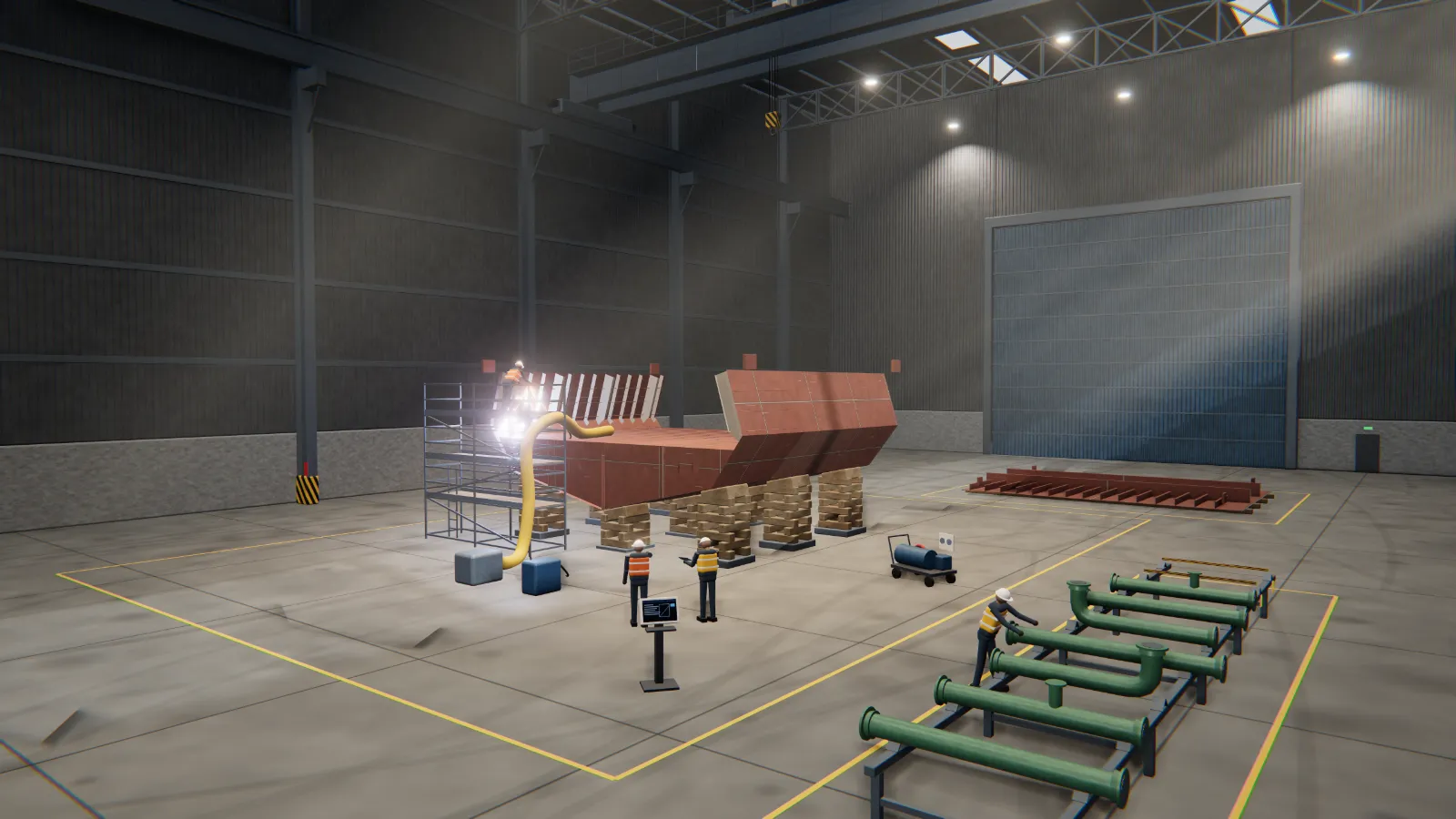
BuildingIn developmentSee it answerConcept visualization. A hull block open at its station, its pipe spool kit beside it. Synthetic model; not a Veldarium facility.
VeldBuild is governed execution and production control, the first layer of the shipbuilder Veldarium is building toward. It settles whether work may start before steel moves, and it needs no AI to do it. It holds what decides the answer: a plate to its heat number and mill certificate, a weld to its procedure and a qualified welder, a block to the blocks it lands on. PLM, ERP, MES and QMS keep their records; VeldBuild would read them through connectors not yet built, and answers ready, not ready or cannot establish, naming the record that decided it and the person who releases the work. A floor measurement counts only once an inspector has accepted it.
Synthetic work package · no production connector · no machinery operated.
A crew is at the work face. Can this work start, and how would anyone know?
Every object in the build carries what governs it, what waits on it, and what proves it.
One synthetic case: an engineering change lands on one block of a concept hull, mid-kit, with one package still 2 spools short. Release the revision and the graph sorts the work into what survives, what must be re-released, and what nobody has assessed. The same rules read every package.
The build, and a change moving through it
Release one revision into a block and follow it: the work it reaches, the work an assessment clears, and who reconsiders the rest.
- Affected
- 2
- Not affected
- 1
- Not established
- 1
- Re-evaluate
- 2
Scroll to release CFG-029 into the graph.
01 At rest Block B30’s build graph: what each package is governed by, what it follows, what it consumes, what shares its zone.Block B30’s build graph, at rest.
02 Change CFG-029 releases DR-118 Rev D; DR-118 Rev C is superseded. Route revised Rev C → Rev D on the seawater cooling spool set.CFG-029: DR-118 Rev D supersedes DR-118 Rev C.
03 Topology The graph finds the candidates: the work the drawing governs, what that work consumes, what shares its zone. Found is not affected.The graph finds the candidates. Found is not affected.
04 Evidence Each candidate is decided by its own assessment. With none on record, the answer stays open; it is never read as clear.Each candidate is decided by its own assessment.
- WP-019Affected · EV-IMP-019, route re-specified
- MAT-441Affected · EV-IMP-441, 2 of 9 spools re-specified
- WP-014Not affected · EV-IMP-014, nozzle moves, foundation does not
- WP-030Not established · no assessment on record
05 Downstream The consequence runs down the predecessor chain. WP-019 and WP-021 need readiness re-evaluated.Down the predecessor chain: WP-019 and WP-021 re-evaluate.
06 Quiet What the change never reached does not move: WP-022, DR-220-A, DR-205-A, MAT-442. Nothing is asked of it.What the change never reached does not move.
07 Authority Configuration authority accepts CFG-029, on EV-IMP-014, EV-IMP-019, EV-IMP-441.Configuration authority accepts CFG-029.
08 New state CFG-029 (Rev C → Rev D) affects 2 object(s) with recorded evidence, is known not to affect 1, and cannot yet establish impact on 1. 2 work package(s) require readiness re-evaluation.WP-019 on Rev D. 2 affected, 1 not, 1 not established.
- Can WP-019 start?
- Not ready. WP-019 may not proceed. Known open: material.
- What holds it
- Material open
- Who releases it
- M. Okafor, Production release authority · B30. VeldBuild records the decision; it does not make it.
Synthetic on VS-001. Each impact mark above is the revision-impact engine’s, and the start answer is the readiness engine’s once the change is accepted; the graph beneath lets you release the change yourself.
DR-118 Rev C governing · stable
- Known affected
- no change in flight
- Known not affected
- no change in flight
- Impact unknown
- no change in flight
- Re-evaluation
- no change in flight
Dependency list (text)
- WP-022 · Pipe penetration & seat prep Downstream: WP-019.
- WP-019 · Seawater cooling spool set depends on WP-022 (requires predecessor), MAT-441 (requires material), DR-118-C (governed by). Downstream: WP-021.
- WP-021 · Cooling equipment installation depends on WP-019 (requires predecessor), MAT-442 (requires material), DR-220-A (governed by).
- WP-014 · Machinery foundation structure depends on DR-205-A (governed by).
- WP-030 · Adjacent zone electrical routing depends on DR-118-C (governed by).
What WP-019 is related to
- governed byDR-118-CDR-118 Rev CConfiguration authority. A new released revision invalidates work captured against the old one.
- requiresMAT-441Seawater spool set kitPrerequisite state. An open requirement holds the dependent object.
- depends onWP-022Pipe penetration & seat prepEstablishedSchedule and readiness. If the predecessor is not accepted, this cannot start.
- needed byWP-021Cooling equipment installationOpen
- 15:04:00observedDR-118 Rev C governing. Introduce CFG-029 to trace impact.
Introduce the controlled change to trace its propagation
3 records were captured against Rev C. None is known to be wrong, but the basis they were taken on no longer governs: each must be re-baselined before it supports Rev D work.
What CFG-029 asks of each object, and who reconsiders it
- MAT-441 · Seawater spool set kitNeedsRe-specify and clear againNeeds re-baselining: Kit B30-019 receipt (captured against Rev C).WhoConfiguration authority
- WP-019 · Seawater cooling spool setNeedsRe-plan against the new revisionNeeds re-baselining: DR-118 Rev C release (superseded); INS-124 plan (captured against Rev C).WhoProduction release authority · B30
- WP-014 · Machinery foundation structureNeedsNothingWhoNo one. It was assessed and is not affected.
- WP-030 · Adjacent zone electrical routingNeedsAssess the impactWhoConfiguration authority
- WP-021 · Cooling equipment installationNeedsRecompute readinessWhoNo release authority on record
Unassessed objects are queued for the change authority by what a late answer would cost (installed work, then open work, then material), never by guessed likelihood.
Move this package’s records on VeldMind: it proposes, a person decides, VeldBuild records Follow the change to every seat it reaches, and the person who decides
One work package, changing state
Each gate is pinned to what it is about. Step it forward: a record changes, a gate moves, VeldMind proposes, and release stays with a person.
Not ready WP-019 may not proceed. Known open: configuration and material.
Which released revision governs WP-019, and is it the one the work is written against?
Change CFG-029 is open against Rev C; the route is held until Rev D is released.
- Who moves it
- Engineering / configuration control
- Who releases the work
- M. Okafor, Production release authority · B30. No software can.
Is the correct material present, and accepted at receipt?
Kit: 2 of 9 spools held, because Rev D re-specifies them; they clear when the reworked and remade ones are accepted at receipt. The material to do the work at the governing revision is not on hand.
- Who moves it
- Receiving / material control
- Who releases the work
- M. Okafor, Production release authority · B30. No software can.
Is the upstream work (WP-022) complete and accepted?
WP-022 complete and accepted; the upstream work WP-019 starts from is closed.
- Who moves it
- Production planning
- Who releases the work
- M. Okafor, Production release authority · B30. No software can.
Is the physical area (zone MS-03) released and reachable for this work?
Zone MS-03 in B30 is released for outfitting; no conflicting hot-work or staging hold is open on the area.
- Who moves it
- Production planning
- Who releases the work
- M. Okafor, Production release authority · B30. No software can.
Are the quality requirements satisfiable, with no open nonconformance blocking the start?
INS-124 (pressure test) is planned as a hold point at completion; no open nonconformance stands against the start of work.
- Who moves it
- Quality
- Who releases the work
- M. Okafor, Production release authority · B30. No software can.
Is the required trade and qualified capacity actually free in the window?
2 pipefitters and 2 pipe welders assigned across 2 shifts, the trades the 9-joint scope requires. Outfit crew capacity (3) is free in the window.
- Who moves it
- Production planning
- Who releases the work
- M. Okafor, Production release authority · B30. No software can.
- ConfigurationKnown open · bindsEngineering / configuration controlSource record CFG-029 · change in flight
- MaterialKnown openReceiving / material controlSource record KIT-B30-019 · material receipt
- PredecessorEstablishedProduction planningSource record WP-022-ACC · predecessor acceptance
- AccessEstablishedProduction planningSource record AREA-MS-03 · area release
- QualityEstablishedQualitySource record INS-124 · inspection plan
- ResourceEstablishedProduction planningSource record CREW-B30-019 · resource assignment
- Readiness
- Not ready
- Binding gate
- Configuration
- Reaches the floor
- No
Two gates are known open. The work cannot start, and the system says which gate binds first.
One revision, traced to the spool and the decision
Which parts change, which lots need review, which operations re-plan, and who may clear the start.
spool trace · synthetic case
One revision, traced to the spool and the decision
Which parts change, which lots need review, which operations re-plan, and who may clear the start.
A The source record
- Drawing
- DWG-B30-019
- Revision
- Rev C superseded · Rev D released
- Line
- SW-COOL-019
- Equipment
- HX-118
- Size
- DN 100
- Material
- 90/10 copper-nickel (class label only; no standard designation claimed)
- Design and test pressure
- Not established in this record
- Work package
- WP-019 · Seawater cooling spool set · block B30
Change rationale, Rev DEquipment data revision moves the HX-118 inlet nozzle 140 mm toward the run. The closure spool shortens by 140 mm and its neighbour re-angles, gaining 35 mm.
B Which spools changed: 2 of 9
| Spool | Rev C length | Rev D length | Change | Tolerance | Connects |
|---|---|---|---|---|---|
| SP-019-01 | 1480 mm | 1480 mm | None | ± 3 mm | header stub HS-30 to SP-019-02 |
| SP-019-02 | 1220 mm | 1220 mm | None | ± 3 mm | SP-019-01 to SP-019-03 |
| SP-019-03 | 960 mm | 960 mm | None | ± 3 mm | SP-019-02 to SP-019-04 |
| SP-019-04 | 1340 mm | 1340 mm | None | ± 3 mm | SP-019-03 to SP-019-05 |
| SP-019-05 | 1100 mm | 1100 mm | None | ± 3 mm | SP-019-04 to SP-019-06 |
| SP-019-06 | 1250 mm | 1250 mm | None | ± 3 mm | SP-019-05 to SP-019-07 |
| SP-019-07 | 870 mm | 870 mm | None | ± 3 mm | SP-019-06 to SP-019-08 |
| SP-019-08 | 1180 mm | 1215 mm | +35 mm | ± 3 mm | SP-019-07 to SP-019-09 |
| SP-019-09 | 1060 mm | 920 mm | −140 mm | ± 3 mm | SP-019-08 to HX-118 inlet nozzle (flanged) |
Source: the parts list of DWG-B30-019 at both revisions, compared field by field. A spool is changed only if a field differs. Fixture and tooling records are not in this package, so their impact is not established rather than none.
C One request, five program states: may OP-10 start?
Rev C governs. The package and its spools match it. Recorded by configuration control.
VerdictReady
No gate open or unknown.
Rev D is released in PLM. Nothing else has moved yet. Recorded by configuration control.
VerdictNot ready
- EngineeringWP-019 released at Rev C; Rev D governs.Configuration control
- EngineeringWork instruction at Rev C; Rev D governs.Production engineering
- Material7 of 9 spools usable; SP-019-08 (LOT-019-08-D, on order), SP-019-09 (LOT-019-09-D, in rework).Materials and quality
The package and its work instruction are re-released at Rev D. Recorded by configuration control.
VerdictNot ready
No longer holdsEngineering: WP-019 released at Rev C; Rev D governs. Engineering: Work instruction at Rev C; Rev D governs.
- Material7 of 9 spools usable; SP-019-08 (LOT-019-08-D, on order), SP-019-09 (LOT-019-09-D, in rework).Materials and quality
The remade SP-019-08 and the trimmed, re-tested SP-019-09 come to receiving. Recorded by receiving.
VerdictNot ready
- Material7 of 9 spools usable; SP-019-08 (LOT-019-08-D, received, not inspected), SP-019-09 (LOT-019-09-D, received, not inspected).Materials and quality
Quality inspects and accepts both spools at Rev D. Recorded by quality engineer.
VerdictReady
No longer holdsMaterial: 7 of 9 spools usable; SP-019-08 (LOT-019-08-D, received, not inspected), SP-019-09 (LOT-019-09-D, received, not inspected).
No gate open or unknown.
D Material when Rev D lands: 7 of 9 usable
| Lot | Spool | Made to | Where it stands | Usable at Rev D |
|---|---|---|---|---|
| LOT-019-01-C | SP-019-01 | Rev C | accepted | Yes. Accepted, conforms to Rev D. |
| LOT-019-02-C | SP-019-02 | Rev C | accepted | Yes. Accepted, conforms to Rev D. |
| LOT-019-03-C | SP-019-03 | Rev C | accepted | Yes. Accepted, conforms to Rev D. |
| LOT-019-04-C | SP-019-04 | Rev C | accepted | Yes. Accepted, conforms to Rev D. |
| LOT-019-05-C | SP-019-05 | Rev C | accepted | Yes. Accepted, conforms to Rev D. |
| LOT-019-06-C | SP-019-06 | Rev C | accepted | Yes. Accepted, conforms to Rev D. |
| LOT-019-07-C | SP-019-07 | Rev C | accepted | Yes. Accepted, conforms to Rev D. |
| LOT-019-08-C | SP-019-08 | Rev C | accepted | No. Accepted against Rev C for SP-019-08; SP-019-08 under Rev D needs a matching engineering approval. A pending substitution is a request, not an approval. |
| LOT-019-09-C | SP-019-09 | Rev C | accepted | No. Accepted against Rev C for SP-019-09; SP-019-09 under Rev D needs a matching engineering approval. A pending substitution is a request, not an approval. |
| LOT-019-08-D | SP-019-08 | Rev D | on order | No. Ordered, not received. |
| LOT-019-09-D | SP-019-09 | Rev D | in rework | No. Being reworked to Rev D and re-tested; not accepted yet. |
Source: the lot records (receiving, quality acceptance, allocation). Usable means accepted by quality, not committed to other work, and made to the governing revision, or substituted under an approval from engineering. Arrival is not acceptance, and a substitution request is not an approval.
E The route: 9 of 9 operations re-plan
| Op | Operation | Labour | Closes | Stops when |
|---|---|---|---|---|
| OP-10 | Identity and kit verificationFitter crew | 2 h | None | A spool is not accepted stock; A spool conforms to a superseded revision |
| OP-20 | Field trim cutFitter crew · pipe cutter class | 3 h | None | No measured as-installed distance on record |
| OP-30 | Weld end preparationFitter crew · bevelling tool class | 4 h | None | Work instruction is not at the governing revision |
| OP-40 | Fit-up and supportTwo pipefitters | 14 h | None | Fitter crew not available; A spool fails identity verification |
| OP-50 | Field joiningTwo pipe welders · arc welding power source class | 22 h | None | Welder qualification not established; Open nonconformance on the run |
| OP-60 | Dimensional verificationLaser scan and machine-vision stations | 3 h | DIM-B30-019 | A recorded dimension outside tolerance; The two methods disagree |
| OP-70 | Weld examinationQualified examiner | 4 h | None | A rejectable indication |
| OP-80 | Flanged connection to HX-118Fitter crew · torque tool class | 2 h | None | Run geometry not accepted (would load the nozzle out of position) |
| OP-90 | Hydrostatic pressure testTest crew · test pump and calibrated gauge | 8 h | INS-124 | Gauge calibration not current; Visible leakage |
Source: the package route. Labour is planned staffed person-hours and sums to 62 h, the package’s planned figure; elapsed time is not established. The route is serial and opens with a check of every spool, so a changed spool re-plans all of it. Not in this route: plate cutting, forming, panel and block assembly; spool fabrication; blasting and coating.
F Who may decide, and what the reasoning layer cannot do
After state 05M. Okafor, Production release authority · B30, may authorize release of OP-10, bound to record 18723f47. A release authorizes the step; the operation counts as done only when the floor records it.
The other five execution scenarios, each recomputed from the same controller
Clean releaseReady
Every domain clear. A named supervisor authorizes fit-up. The operation is released, not performed.
No gate open or unknown.
Material shortageNot ready
A spool on the dock is not a spool in the run, and a pending substitution is a request. The package cannot be declared complete.
- Material7 of 9 spools usable; SP-019-08 (LOT-019-08-D, received, not inspected), SP-019-09 (LOT-019-09-D, in rework).Materials and quality
Inspection failureNot ready
Both methods agree the closure spool is 4.5 mm long against a 3 mm tolerance. The finding goes to a quality engineer; the reasoning layer recommends and cannot disposition.
- QualitySP-019-09 measured 924.5 mm against 920 ± 3 mm (+4.5 mm).Quality engineer
- QualitySP-019-09 measured 924.3 mm against 920 ± 3 mm (+4.3 mm).Quality engineer
- QualityNCR-019-04 awaits disposition.Quality engineer
Conflicting evidenceCannot establish
Two quality records of equal authority disagree. The system keeps both, does not let the floor report break the tie, and asks the person who owns acceptance.
- QualityDIM-B30-019: Sources of equal authority disagree for DIM-B30-019: accepted (QMS-INS-2201) vs rejected (QMS-INS-2207). A person resolves this; the system will not pick, average, or take the newest.Quality engineer
Recommendation rejectedNot ready
VeldMind proposed recovering a shift by bolting up early. A planning lead rejected it with a reason; the rejection is on the record and nothing on the floor moved.
- EngineeringOP-80 (Flanged connection to HX-118) depends on OP-60 (Dimensional verification); the route forbids the swap.Production engineering
The audit chain links each entry to the one before it, so an edited or removed entry is detected. It is change detection on a synthetic record, not a signature.
What the workpiece returns, and what it may establish
A measurement, checked against an independent second read, enters the as-built record or does not. Recording is not acceptance.
returned evidence · synthetic scenario
What the workpiece returns, and what it may establish
A measurement, checked against an independent second read, enters the as-built record or does not. Recording is not acceptance.
measurement uncertainty
- This measurement
- accepted
- Package acceptance plan
- 1 of 2 hold points satisfied · INS-124 (pressure test) outstanding
- As-built record
- Recorded. It states this measurement, not acceptance of the package
- Governing revision
- Rev D
↶ The measurement returns to governed truth and is recorded. It does not accept the package: INS-124 (pressure test) has no evidence yet, and every hold point in the plan must be satisfied before the package is accepted.
Why the answer is not held anywhere
Whether a package can start depends on six systems. None of them holds the answer.
Composing their records is nobody’s job, so the crew finds out at the work face. VeldBuild holds the relationships that decide it:
- A plate or material lot its heat, grade, certificate and acceptance, and the revision its parts were nested from.
- A weld joint its procedure, the welder’s qualification and the inspection that accepts it.
- A pipe spool or cable run the revision it was built to, its test, and the location it installs into.
- A structural unit or block its predecessors, its outfit and its dimensional check before the lift.
- A machinery foundation its alignment within tolerance before equipment is set on it.
- A work package its material, procedure, work area and the person who releases it.
- A machine or tool its qualification and maintenance state for the operation.
- A change every object it reaches, and every package it holds until resolved.
- An inspection or measurement the claim it supports, whether it was accepted, and how long it stays valid.
- Accepted and as-built state what exists as built, moved only by accepted evidence.
The same question, put to each of the six systems
“Can this package start this shift?”Asked by the supervisor at the work face, 06:40. Every system below answers its own question correctly. None of them answers this one.
- Engineering · PLM
- SaysDesign at Rev C. Change CFG-029 open.
- Cannot seeHolds the design. Has not released the revision the work is written against.
- ConfigurationKnown open
- Supply · ERP / receiving
- Says9 spools bought; 2 held at the dock.
- Cannot seeCounts what was purchased and landed. Not whether the kit is accepted for this work.
- MaterialKnown open
- Production · MES
- SaysWP-022 run and closed on the floor.
- Cannot seeRecords execution. Not the gates the next package still has to clear.
- PredecessorEstablished
- Yard ops · area control
- SaysZone MS-03 released for outfitting.
- Cannot seeOwns the physical area. Not the schedule pressure landing on it.
- AccessEstablished
- Quality · QMS
- SaysINS-124 hold point set. No open nonconformance.
- Cannot seeGoverns acceptance at completion. Not whether the work may start.
- QualityEstablished
- Planning · scheduling
- SaysWP-019 in this week’s plan; crew assigned.
- Cannot seeKnows the sequence. Not the physical gates underneath it.
- ResourceEstablished
Two of the six conditions this work depends on are not established. They sit in two different systems and belong to Engineering / configuration control and Receiving / material control. The crew is at the bench now.
How it would run on a yard’s records
Everything above runs on synthetic records. Below is what changes on a yard’s records: computed where the engines already run, marked as design where they do not.
What it reads from PLM, ERP, MES, QMS and planning
- PLM and released drawingsReadsReleased drawing and model revisions, change orders with their status and effectivity, and the part and spool lists each revision carries.BecomesDrawing · Revision · Change order · Configuration baseline · PartNeverIt never releases, edits or supersedes a revision. Configuration control closes a change in PLM, and VeldBuild reads that it was closed.May decideWhich revision governs an objectBears on, never decidesGeometry and model state · The controlled document and its approval stateFeeds, in the demonstrationConfiguration gate (CFG-029, change in flight)
- ERP and material controlReadsPurchase order lines and the revision each was ordered against, goods receipts, heat and lot numbers with their certificates, stock location and kit allocation.BecomesPurchase order · Material · Material lot · SupplierNeverIt never reads a receipt as acceptance. ERP knows the material arrived; whether it may be used is a quality judgment made elsewhere.May decideWhat was ordered, shipped and receivedBears on, never decidesWhether received material was accepted · Program and customer contextFeeds, in the demonstrationMaterial gate (KIT-B30-019, material receipt)
- MES and the floorReadsOperation status as the floor reports it (started, complete, suspended) and the work package each operation belongs to.BecomesOperation · Work packageNeverIt never reads “complete” as “accepted”. A finished operation is execution state; the predecessor gate also needs the inspection that accepts it.May decideWhat the floor reports as executedBears on, never decidesWhether an inspection accepted the workFeeds, in the demonstrationPredecessor gate (WP-022-ACC, predecessor acceptance)
- QMS and inspectionReadsInspection and test plans with their hold points, inspection results, nonconformances and their dispositions, and receipt inspection of material.BecomesInspection · Test · Nonconformance · Hold · AcceptanceNeverIt never accepts, rejects or dispositions anything. An inspector or the review board decides in QMS, and VeldBuild records the decision with the record it rested on.May decideWhether received material was accepted · Whether an inspection accepted the workFeeds, in the demonstrationMaterial gate (KIT-B30-019, material receipt); Predecessor gate (WP-022-ACC, predecessor acceptance); Quality gate (INS-124, inspection plan)
- Planning and schedulingReadsArea and zone release for the window, crew and trade assignments, and bookings of cells, cranes and stations.BecomesZone · Trade · Resource · MachineNeverIt never reschedules. Where two packages compete for one cell, the resource gate reads open and names who owns the window.May decideThe schedule of recordFeeds, in the demonstrationAccess gate (AREA-MS-03, area release); Resource gate (CREW-B30-019, resource assignment)
Every connector these rows need is at Target: none is built, and every record on this site is synthetic. The other systems a yard runs, and what each may establish, are on Systems.
How a record earns the right to decide
- 01
Read, under access agreed in writing
One connector per system reads the records that govern the work area, with the credentials and on the schedule the yard grants. It holds read access only. Nothing is written back.
Target - 02
Resolve each identifier to one object
The yard’s drawing, part, heat and package numbers map to governed objects through a table the yard’s own people review. An identifier that maps to no object, or to two, is never guessed: every answer that needs it reads cannot establish until the mapping is settled.
Target - 03
Keep where it came from
Every record keeps nine fields of provenance, so any answer traces back to the native record behind it. The demonstration’s records carry a subset: the record, its issuer, the object and revision it was captured against, and when.
Concept - 04
Admit it, or turn it away with a reason
A record about another object, captured against a revision that no longer governs, not yet effective, or from a system not permitted to bear on the question never enters the answer. It is kept, with the reason it was turned away.
Synthetic - 05
Let only the owning system decide
A system permitted only to contribute never decides, however many contributing records agree. Two permitted records that disagree resolve by configured precedence or not at all: the answer is cannot establish, and a person reconciles them. Recency never decides.
Synthetic
The rule, run on five synthetic situations. The record ids are invented; the answers are computed.
- ERP shows the kit received in full. Quality has recorded nothing yet.AnswerCannot establishWhy1 record bears on Kit B30-019, but none comes from a source permitted to establish this class. Contributing evidence never becomes a governing answer.
- Quality records the receipt inspection of the same kit as accepted.AnswerEstablishedWhyQMS establishes whether received material was accepted for Kit B30-019 (RI-0419, owned by Quality).
- PLM has released the new revision. The document system still holds the old drawing.AnswerEstablishedWhyPLM establishes which revision governs an object for DR-118 (PLM-REL-2207, owned by Configuration control).
- Two receipt inspections of the kit, both in QMS, disagree.AnswerCannot establishWhySources of equal authority disagree for Kit B30-019: accepted (RI-0419) vs rejected (RI-0420). A person resolves this; the system will not pick, average, or take the newest.
- The only acceptance on file was recorded against the revision the change superseded.AnswerCannot establishWhyNo admissible record establishes this claim for Kit B30-019. Not admitted: RI-0419 was captured against Rev C, not Rev D.
The six readiness gates, and why unknown is never a pass
Readiness is a three-valued conjunction, not a checklist score. One gate known open makes the package not ready, whatever the others say. With none open, one gate that cannot be established makes the answer cannot establish. Only when all six are established from current records is it ready. The gates, as the demonstration configures them:
- ConfigurationAsksWhich released revision governs WP-019, and is it the one the work is written against?Satisfied bychange in flightCounts forValid until supersededOwner when not establishedEngineering / configuration controlIn the demonstration nowOpenChange CFG-029 is open against Rev C; the route is held until Rev D is released.
- MaterialAsksIs the correct material present, and accepted at receipt?Satisfied bymaterial receiptCounts forValid until the object or configuration changesOwner when not establishedReceiving / material controlIn the demonstration nowOpenKit: 2 of 9 spools held, because Rev D re-specifies them; they clear when the reworked and remade ones are accepted at receipt. The material to do the work at the governing revision is not on hand.
- PredecessorAsksIs the upstream work (WP-022) complete and accepted?Satisfied bypredecessor acceptanceCounts forValid until the object or configuration changesOwner when not establishedProduction planningIn the demonstration nowEstablishedWP-022 complete and accepted; the upstream work WP-019 starts from is closed.
- AccessAsksIs the physical area (zone MS-03) released and reachable for this work?Satisfied byarea releaseCounts forDescribes one momentOwner when not establishedProduction planningIn the demonstration nowEstablishedZone MS-03 in B30 is released for outfitting; no conflicting hot-work or staging hold is open on the area.
- QualityAsksAre the quality requirements satisfiable, with no open nonconformance blocking the start?Satisfied byinspection planCounts forValid until the object or configuration changesOwner when not establishedQualityIn the demonstration nowEstablishedINS-124 (pressure test) is planned as a hold point at completion; no open nonconformance stands against the start of work.
- ResourceAsksIs the required trade and qualified capacity actually free in the window?Satisfied byresource assignmentCounts forDescribes one momentOwner when not establishedProduction planningIn the demonstration nowEstablished2 pipefitters and 2 pipe welders assigned across 2 shifts, the trades the 9-joint scope requires. Outfit crew capacity (3) is free in the window.
An unknown gate means a record that should exist cannot be found, or was taken on a basis that has since moved. Reading it as a pass sends a crew to cut, fit and weld against something nobody has checked, and the cost lands in steel: rework, re-inspection, a block that waits for its neighbor.
Reading it as a fail sends the wrong person. A known-open gate needs its owner to close it; an unknown one needs someone to find or re-baseline a record, and nothing about the work may be wrong. So the three answers stay apart, and each offers the release authority different actions.
- ReadyThe release authority mayAuthorize release · HoldAuthorize release: Work is released against the evidence set as it stands at this moment. Hold: No gate is open; a hold records that the named person chose to wait, and the verdict is unchanged.
- Not readyThe release authority mayHoldHold: A gate is known open. Someone closes it; the verdict recomputes from the record, not from this decision.
- Cannot establishThe release authority mayHold · Return for evidenceHold: A gate cannot be established. Release is withheld until the record is located; the verdict recomputes from the record, not from this decision. Return for evidence: A gate cannot be established. Someone locates or re-baselines the missing record. Nothing about the work is asserted to be wrong.
Across all 256 combinations of the eight program events on the readiness console, the engine answers ready in 1, not ready in 248 and cannot establish in 7. Ready is the narrow answer, as it should be: every gate has to hold at once.
How a change travels through the build graph
- 01
The build graph finds the candidates
From the revised drawing, VeldBuild follows the build graph to the work, material and neighboring work the change could reach. That set is what might be affected, and nothing more.
- 02
An assessment record decides each one
A candidate is known affected or known not affected only when an impact assessment says so. One nobody has assessed, or one whose assessments disagree, is impact not established: never read as unaffected, never settled by picking one assessment, and queued for the change authority.
- 03
Evidence on the old basis stops counting, and is kept
Records captured against the superseded revision no longer establish their gates, so those gates read cannot establish, not open: the record may still be right, but it was taken on the old basis. Nothing is deleted, and a release given on the old basis is refused under the new one.
- 04
Work downstream recomputes
Packages that wait on affected work have their readiness recomputed, and each names the role that releases it. The change reaches the floor as named holds, not as a rumour.
In the demonstration, CFG-029 reaches 5 objects: 2 known affected, 1 known not affected, 1 not yet assessed, and 1 downstream package that must recompute. 3 records stop establishing what they did. Each one, and who reconsiders it, is under the graph.
Who releases the work, and what is recorded
VeldBuild computes whether a package is ready. It never releases one. Release belongs to one named person for the work area, who decides against the evidence as it stands, and VeldBuild records the decision with that evidence attached. Authorize release is offered only on a ready verdict; a decision recorded on one basis does not survive a change to it.
In the demonstration, release for the area is held by M. Okafor, Production release authority · B30. The package is not ready, so VeldBuild offers hold, and records the decision:
Decision
AUTH-WP-019-HELD
Action
Hold
Verdict when decided
Not ready
Decided by
M. Okafor, Production release authority · B30
Rationale
Held: configuration and material known open. Release withheld until they close.
Evidence it rested on
CFG-029 · KIT-B30-019 · WP-022-ACC · AREA-MS-03 · INS-124 · CREW-B30-019
Recommendation it answered
REC-WP-019-NOT-READY
A first deployment, on one work area
In a yard, the gates are configured, not coded: which gates apply to the area’s packages, which record satisfies each, how long that record counts, and who owns the gate when it is not established. The six gates above are the demonstration’s configuration; a deployment writes the yard’s own, with the people who hold those gates today.
- The boundaryOne work area: the work packages of one block, zone or module, and the release decisions made on them.
- Who uses itThe release authority for the area, the planners who prepare its packages, and a reviewer who checks answers against their sources.
- What it readsRead access to the records that govern the area: revisions in PLM, material in ERP, work in MES or planning, inspection in QMS. Nothing is written back.
- What is configuredConnectors to those systems, the mapping of the customer’s identifiers into governed objects, the release gates its acceptance plans require, and its authority roles.
- What stays with peopleRelease, engineering disposition and quality acceptance. VeldBuild computes and records; the named authority decides.
- What it producesA recorded readiness answer for every package in the area, measured against a baseline agreed before anything is connected.
- 01
Name the work area
The block, zone or module, the release decisions made on it, who holds them and what a wrong release costs. Stops if no release there is rebuilt by hand.
- 02
Agree access
Read access, data rights, handling, the baseline and the success and stop conditions, in writing. Stops if access cannot be made safe and testable.
- 03
Run alongside
VeldBuild reads the area’s records and answers beside current practice, so every answer is checked. Stops if answers do not survive review.
- 04
Extend or stop
Your release authority and reviewer decide whether it extends to the program. If it extends, the connectors and mapping carry forward.
Built once, carried between yards: The governed build-state model and its object classes · The readiness, change-impact, evidence and authority engines · The decision record · VeldMind’s bounded reasoning · A connector for each kind of source system. Configured for each yard: Read access and data rights for the customer’s systems · Mapping of its identifiers, work packages and revisions · Its release gates, acceptance plans and authority roles. The engines run today on synthetic records and are tested in Veldarium’s code. The standalone application is in development, and no connector exists yet.
TargetWork-area deploymentThe offer, and what each side keeps
What would prove it worth keeping
Nothing here has been measured, because VeldBuild has not run on a yard’s records. These are the outcomes a production director would watch on the first work area, each against a baseline agreed before any record is read. None carries a figure, and none is claimed.
- Less time rebuilding the current state by hand from several systems.Measured byTime from a question to an answer the reviewer accepts, against a baseline agreed before anything is connected.Where the worked case shows it
- Earlier sight of what a change reaches, and of what nobody has assessed.Measured byAffected objects found before work started against those found after, on reviewed changes.Where the worked case shows it
- Fewer packages released while a condition is still open.Measured byHow often released work was later found blocked, before and after.Where the worked case shows it
- The binding constraint and its owner named, instead of a status color.Measured byWhether the named owner was the person who actually cleared the gate.Where the worked case shows it
- Evidence that stays attached to the decision it supported.Measured byWhether every source cited in a decision survives an independent review.Where the worked case shows it
- Clear ownership of each consequential decision, recorded where the next person can check it.Measured byWhether the release authority acts on the answers without authority moving off the people who hold it.Where the worked case shows it
The work area earns the next level when: The answers survive the customer’s technical and operational review, and the release authority acts on them without authority moving off the people who hold it. VeldBuild itself would be scored on: Readiness verdict correctness · Unknown preservation · Change-impact precision and recall · Authority-resolution correctness · Configuration and effectivity correctness · Provenance completeness · Source-conflict detection · Deterministic reproducibility.
TargetEvery outcome above
How it fails, and why every failure ends in a hold
Every failure below ends in a held package or a refused decision, never in a release. Software that is wrong in the open direction puts a crew on unchecked work; software that is wrong in the closed direction costs a planner an hour. VeldBuild is built to be wrong only in the second way.
- A record a gate needs cannot be found, or its link is broken.VeldBuild answersThe gate reads cannot establish, and so does the package. Authorize release is not offered; the release authority may hold or return it for evidence.Who actsThe gate’s owner, to find or relink the record.Synthetic
- Evidence was cleared against a revision that no longer governs.VeldBuild answersThe gate it supported drops to cannot establish, never to open, and the record stays on file as what was true then.Who actsWhoever captured it, to re-baseline it against the governing revision.Synthetic
- Two records from systems permitted to decide disagree.VeldBuild answersCannot establish, with both records and their values shown. No vote, no average, and never the newer one.Who actsThe authority that owns the fact, to reconcile them in its own system.Synthetic
- A system that may only contribute says yes: ERP shows the material received.VeldBuild answersThe record is kept as context and decides nothing. Material acceptance still waits on quality.Who actsQuality, through receipt inspection.Synthetic
- Someone tries to release a package that is not ready.VeldBuild answersVeldBuild refuses the record outright. Approval is never offered on a package with an open or unknown gate.Who actsNo one can; the gate has to close first.Synthetic
- A release was given, and then the revision it rested on was superseded.VeldBuild answersThe earlier approval is refused under the new revision. It is not carried forward.Who actsThe release authority, deciding again on the new basis.Synthetic
- Two measurements of the same work disagree.VeldBuild answersConflicting evidence: the as-built record is held. Readings are never averaged into a pass, and a sensor never accepts its own work.Who actsThe named inspector.Synthetic
- A connector stops updating, or a source system is unreachable.VeldBuild answersAnswers that depend on its records stop being current, and read cannot establish rather than repeating the last good value.Who actsThe yard’s system owner and the integration owner.Concept
- A yard identifier maps to no governed object, or to two.VeldBuild answersNothing is guessed. Every answer that needs it reads cannot establish until the mapping owner settles it.Who actsThe mapping owner named for the deployment.Target
- VeldBuild itself is unavailable.VeldBuild answersNo answer is not a yes. The area releases work the way it does today, and every source system is untouched, because nothing was ever written into one.Who actsThe release authority, by current practice.Concept
The model under the demonstration
Three of ten operator surfaces and three of the six build-state questions run on a deterministic engine above. What each system a yard runs may establish is on Systems.
The build model: what it holds, and how state moves
- 01
Engineering state
The definition allowed to govern the work.
Requirement · Configuration · Revision · Release · Change · Effectivity · Interface definition
- 02
Supply state
What was required, sourced, received, inspected, accepted, substituted, certified and staged.
Requirement · Source · Purchase · Receipt · Inspection · Acceptance · Shortage · Substitution · Certification · Staging
- 03
Production state
The lifecycle of the bounded work, without averaging unknowns into progress.
Planned · Ready · Released · Underway · Waiting · Blocked · Completed · Inspected · Accepted
- 04
Quality state
The conditions and evidence between performed work and accepted work.
Required inspection · Hold point · Nonconformance · Disposition · Repair / rework · Acceptance · Evidence
- 05
Physical state
What actually exists, where it is, and how it differs from intent.
Location · Installed configuration · Interface completion · Access · Sequence · As-built condition
- 06
Authority state
The source and person allowed to make a consequential state transition.
Governing source · Named role · Decision scope · Approval · Exception · Waiver · Expiration / effectivity
Product definition
Program · Vessel · Variant · System · Subsystem · Zone · Compartment · Block · Module · Assembly · Part · Asset
What is the vessel, and how is it decomposed?
Engineering authority
Requirement · Specification · Drawing · Model · Revision · Configuration baseline · Change order · Release
What defines the object, and which definition controls?
Supply and material
Material · Supplier · Purchase order · Material lot
What was sourced, received, certified, and made applicable?
Work and resources
Work package · Operation · Trade · Resource · Machine · Tool
What must happen, in what sequence, with which bounded resources?
Quality and acceptance
Inspection · Test · Nonconformance · Deviation · Waiver · Hold · Acceptance
What proves the work, what exception remains, and who accepted it?
Physical and as-built state
As-built record
What physically exists, where is it, and what record survives delivery?
Typed relationships connect them: requires · satisfies · supersedes · installed in · located in · depends on · blocked by · released by · inspected by · accepted by · sourced from · affected by · governed by · derived from · configured as · connected to.
A revision governs because it is effective, not because it is newest. Each one moves through: Created · Reviewed · Approved · Released · Superseded · Effective for a program, hull, zone, object, or time window · Field exception or approved deviation · As-designed · As-planned · As-built.
Evidence counts for as long as its kind allows: Valid until superseded · Valid until the object or configuration changes · Valid until a declared date · Describes one moment. A record that stops being current reads superseded, basis changed, validity window elapsed, and is kept as what was true then.
State moves only on a recorded event: Created · Revised · Released · Superseded · Held · Installed · Inspected · Accepted · Nonconformance opened · Nonconformance closed · As-built reconciled.
How far each operator surface is built
- 01Build controlConceptOverall governed state, and the exceptions that need a person now.
- 02Build graphSyntheticThe typed dependency and configuration graph for any object.
- 03Readiness queueSyntheticWhat may start, what may not, and what cannot yet be established.
- 04Change impactSyntheticWhat one revision affects downstream, and what it does not.
- 05Material exceptionsConceptShortage, wrong revision or lot, late arrival, and provenance gaps.
- 06Quality & acceptanceConceptHold points, inspections, nonconformances and acceptance evidence.
- 07ConfigurationConceptWhich revision and effectivity govern which object right now.
- 08Evidence ledgerConceptWhy the system believes the current state: the records behind it.
- 09Integration healthConceptWhich external sources are healthy, stale, conflicting or unavailable.
- 10As-builtLong-termWhat was actually installed and accepted versus what was intended.
The formal definition of three-valued readiness
verdict(w) = min_{g ∈ gates(w)} state(g) on open < unknown < established
- gates(w)
- the six gates of work w: configuration, material, predecessor, access, quality, resource
- state(g)
- three-valued gate state ∈ { open, unknown, established }
- verdict(w)
- open reads NOT_READY, unknown reads CANNOT_ESTABLISH, established reads READY
One known-open gate makes the verdict NOT_READY whatever the others hold. With none open, one unknown gate makes it CANNOT_ESTABLISH. READY needs every gate established. Unknown is never counted as established and never folded into open, and VeldBuild runs exactly this rule.
Ready is not authorized is not released is not permitted is not accepted
- May this unit of work lawfully begin at all?AboutOne work package, under the revision that governs itEstablishes a fact from evidenceDoes not decideIt does not decide that any particular cell can do the work. A package can be READY while every cell qualified to execute it is held, uncalibrated or busy.
- Can this exact cell perform this exact work, against this exact basis, right now?AboutOne workcell, for one work package, at one revision, at one evaluation timeEstablishes a fact from evidenceDoes not decideIt does not start the work and it is not a safety system. Machine safety is a separate, dominant authority that can inhibit motion on a fully authorized cell, and no Veldarium software may clear it.
- Has a named person actually said go?AboutOne release decision, by one named authority, for one work packageA named person decidesDoes not decideIt does not make the machine move, and it does not survive a change in what it rested on. Release is recorded against the evidence set that existed when it was taken; a revision that supersedes that basis withdraws the authorization rather than carrying it forward.
- Is motion permitted right now, by the system that owns that question?AboutOne cell, continuously, not once at the start of the workA separate system reports its own stateDoes not decideIt does not authorize work and it does not accept quality. An inhibited cell is not a defective package, and a clear inhibit is not a release.
- May what came back off the workpiece enter the governed record?AboutOne measurement, against one hold point in the governing acceptance planEstablishes a fact from evidenceDoes not decideA sensor never accepts its own work. It establishes a bounded physical fact with an uncertainty; a named quality authority decides acceptance, and a rejected measurement is real evidence that does not satisfy a threshold.
Three questions, three subjects, three engines. Approved is not executable and executable is not accepted: a package can be READY while no cell may run it, and a cell can be AUTHORIZED while what comes back off the workpiece is rejected. Every verdict here is computed from synthetic teaching fixtures; Veldarium authorizes no cell and operates no machine.
If your team rebuilds this answer by hand, start with one work area. Send the release decision, the systems that hold its records, and its owner. chris@veldarium.com