Buying a machine does not create capacity.
Capacity is every condition true at once.
If the yard cannot build it, how is the missing capability created?
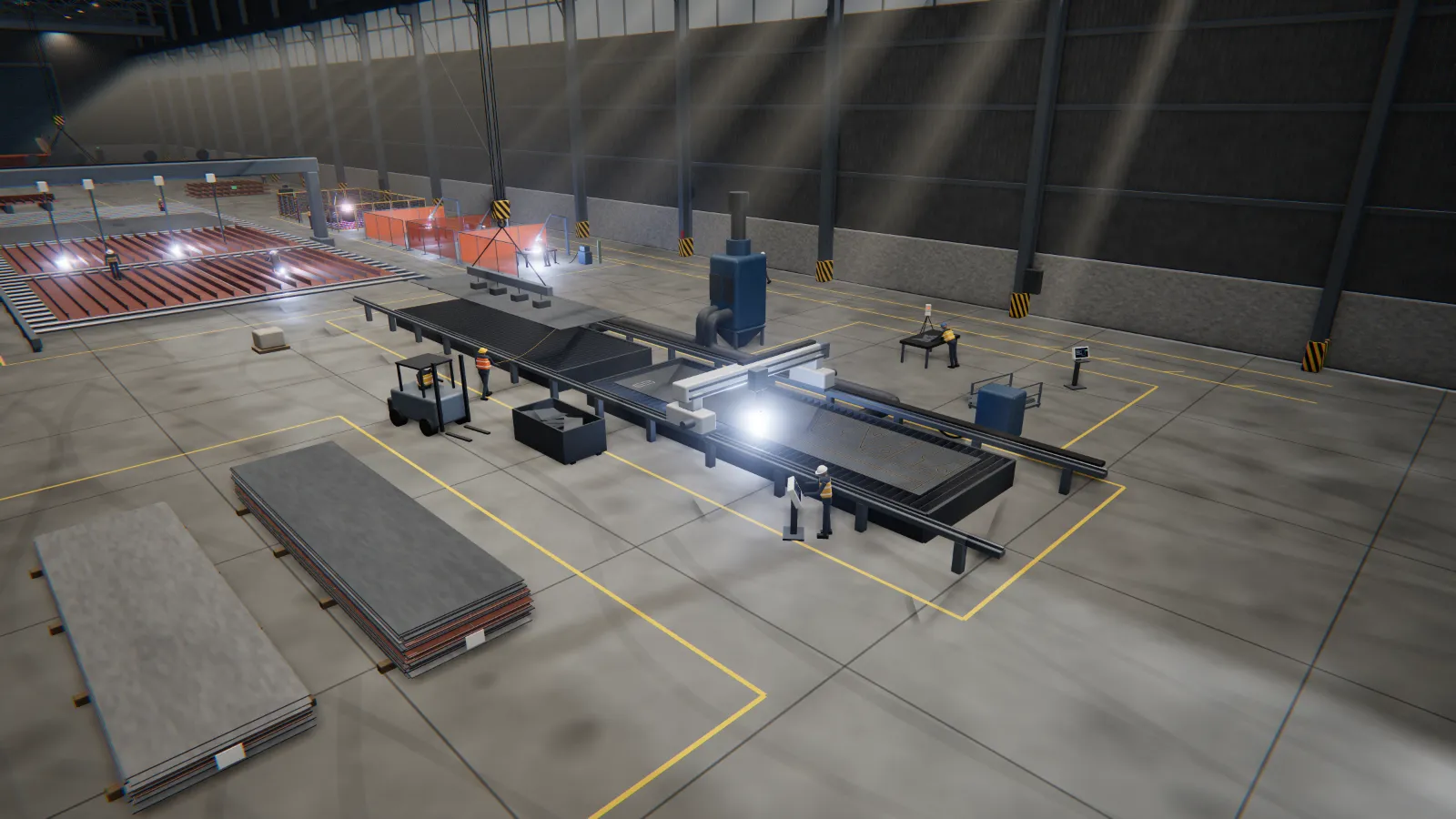
Concept visualization. A production hall: plate cut, welded into panels and built into blocks. Synthetic model; not a Veldarium facility.
Industrial Base ends on the most loaded station. On the nominal plan every station is under its capacity; under a surge in demand, capacity must be added. This page follows one machine from purchase order to rate, with the arithmetic of what it adds and the person who signs each step.
Architecture and synthetic evaluation. Veldarium owns no yard, has qualified no supplier and has industrialized nothing.
One machine, worked through
A plasma table can be bolted to the floor and still not be capacity.
Ordered, delivered, installed, commissioning, qualified: a schedule may plan against none of those states. Released, the table still loses hours to setup, maintenance and faults, and parts to rework. Synthetic
- Staffed hours in the windowInputCertified burners / nesting programmer; one qualified setter per shift.
- Nameplate160 h × 15 plate parts per hour (qualified rate)What the hours and the qualified rate promise, before anything goes wrong.
- After availability× 0.85 (−360)Uptime after setup and changeover, calibration, maintenance and faults.
- Accepted first time× 0.98 first-pass yield (−40.8)Parts that pass inspection first time. A rejected part consumes capacity twice. Material identity at receipt; first-part dimensional check.
Against a demand of 1600: 1600 ÷ about 1999 is 80% of effective capacity, a margin of about 399. This class is not the most loaded.
- Upstream engineering release
- Nests are cut from the released revision. Cutting cell calibration record; nesting program at governing revision.
- Downstream process
- Accepted parts are capacity only if the panel line can take them; that is the next class in the model, not this one.
- Facility
- Covered steel-prep bay; plasma table power and extraction.
- Before added hours count
- Outside cutter qualified (first-article + material-cert flow) before its hours count as capacity.
The same machine, as a cell
Withdraw any one condition and the cell may not start.
The arithmetic assumes the cell may run. Whether it may is a separate question: pull any switch for the verdict on that combination and who must act.
Authorized
CUT-02 · AUTHORIZED: every one of the 14 applicable prerequisites is positively established.
Who must act: Production supervisor · B3014 of 14 applicable prerequisites established
What it returns, once it has run
Even with every condition established, the cell starts only when D. Ferreira, a named and qualified person, authorizes it. No software can.
From constraint to production capacity
- 01 ConstraintPanel line weld is the most loaded, at 90%On the sprint, 3 days of queue form at the panel line. The diagnosis
- 02 Capability neededRecover uptime on the panel line weld: setup reduction and planned maintenance. Winning back half of the downtime and setup takes availability from 82% to 91%: 201 more weld-meters of capacity in the window, on hours the class already has.Utilization is 90% of effective capacity, with 182 weld-meters of margin.
- 03 CandidateNo machine is bought for thisNothing has to be added to meet demand: the panel line weld already covers it with 182 weld-meters to spare, and the recovery widens that to 383. It buys headroom, not output.
- 04 QualificationRecovered capacity is evidenced tooRecovered uptime counts only once the panel line weld's downtime and setup records show it held over a sustained window; a plan is an intention, not uptime.Every stage
- 05 Released capabilityReleased by the production supervisorOnly a released asset is capacity a schedule may plan against.
- 06 Production effectThe diagnosis is recomputedIt never becomes unconstrained: structural weld (robotic + manual) becomes the most loaded, at 87%.
- Candidate
- Selected
- Ordered
- Delivered
- Installed
- Commissioning
- Qualified
- Released · capacity
A bottleneck fix is approved. What must become true before the program may plan against it?
An asset can be in eleven states. A schedule may count two.
Only released and restricted count, and restricted only within the scope or rate it was released to. Before release the machine passes factory and site acceptance and safety validation, the process is proven on it, and each operator is qualified to the approved procedure.
One constraint, one resource, every gate between them
Ordered is not installed, installed is not qualified, qualified is not released.
synthetic
One constraint, one resource, every gate between them
Ordered is not installed, installed is not qualified, qualified is not released.
Panel line weld
90% utilization · most loaded
Recover uptime on the panel line weld: setup reduction and planned maintenance. Winning back half of the downtime and setup takes availability from 82% to 91%: 201 more weld-meters of capacity in the window, on hours the class already has.
Production assetWELD-R09
Third robotic weld cell (proposed)
Candidatedoes not count as capacity
A technology under evaluation. Nothing committed.
Proposed against structural weld (robotic + manual): The weld deficit under equipment-downtime and surge scenarios.
- 01
Need identified here now
- Asks
- Which constraint would this asset actually retire?
- Evidence
- A named capacity deficit or hazard/ergonomic case tied to demand.
- Owner
- Manufacturing engineering + production planning.
- Holds if
- No constraint, no asset. Capability for its own sake is rejected.
- 02
Process requirement
- 03
Candidate technology
- 04
Benchmark
- 05
Integration specification
- 06
Procurement authority
- 07
Factory acceptance test (FAT)
- 08
Site installation
- 09
Site acceptance test (SAT)
- 10
Safety validation
- 11
Process qualification
- 12
Operator training
- 13
Production release
- 14
Maintenance & spares
- 15
Performance monitoring
Until it is released, the program counts nothing
Panel line weld stays at 90%. The schedule may not plan against this resource. Released, it would relieve structural weld (robotic + manual), not panel line weld, which stays the most loaded class, so the demand the line could absorb does not move.
How much executable capacity a specific released asset adds cannot be established from this model. The throughput model carries intervention scenarios that move a whole class’s inputs; none of them is a measured contribution from one machine, and none is presented as one.
The path by process step, and the blueprint it groups
Each step's status is the weakest of the sixteen blueprint stages it covers.
concept architecture
The path by process step, and the blueprint it groups
Each step's status is the weakest of the sixteen blueprint stages it covers.
01Process
What is the work, at what rate, and how is it done?
Hands on A work-content model and a cell design
Blueprint Program demand & work content · Make / buy / partner · Process & production-cell design
Concept02Standard
Is there one approved way to do it, and are the sources, people and safeguards qualified to it?
Hands on A qualified procedure, source and crew
Blueprint Supplier & sub-tier qualification · Workforce roles, skills & qualification · Safety engineering · Quality planning & measurement
Concept03Measurement
Does the standard hold when the work is done for real?
Hands on First-article and monitored results
Blueprint Pilot / first article · Supplier & line monitoring
Target04Learning
What did the results teach, and did the standard change because of it?
Hands on A revised standard, fed back to engineering
Blueprint Production evidence → engineering
Concept05Tooling
What is now worth encoding in equipment, fixtures and space?
Hands on Assets specified against a retired constraint
Blueprint Equipment & automation selection · Facility, utility & material flow · Capital plan & commissioning sequence
Concept06Capacity
Is it released by a named person, sustained, and at rate?
Hands on Capacity a schedule may plan against
Blueprint Production release · Rate ramp · Maintenance & reliability
Target
Learning revises the standard. For every process a yard adds, the path is walked again; it is a loop, not a line walked once.
TodayOf the 16 blueprint stages beneath this path, 1 is synthetic (program demand & work content), 12 are concept and 3 are target. Every step is modeled; none is operated.
Program demand & work content
What work, at what rate, to what acceptance criteria?
Synthetic- Input
- Vessel requirement, configuration, work breakdown, schedule and rate.
- Owner
- Program + engineering.
- Evidence
- A work-content model per capability class over the demand window.
- Decision
- Baseline the demand the industrial system must satisfy.
- Hold / failure
- Undefined rate or acceptance criteria makes every downstream number a guess.
- Downstream
- Every capacity, supplier, capital and workforce number derives from this.
- Metric
- Work content by class; rate; acceptance criteria coverage.
From requirement to rate
Eight steps from a requirement to capacity at rate, on the same table.
The table counts as capacity from acceptance and release, step 7, not from delivery. Open a step for its money, people, failure modes and evidence.
01RequirementWhat work must the capacity do, and which constraint does it retire?Selected · not capacity
- The work
- Write the requirement as work, not as a machine: the parts, material and thickness range, tolerance, rate and acceptance criteria, and the constraint it is meant to retire. Decide make or buy, design the cell around the flow, screen candidate technologies, benchmark the shortlist on representative parts, and specify how the winner fits the cell: utilities, safeguards, material handling and data.
- The plasma table’s record
- Plasma cutting cell: 1600 plate parts must be accepted in one window. That number, not the table, is the requirement.
- Finance
- No capital yet. What is spent is engineering time, and what it protects is every later decision: a machine bought against a vague requirement can never be accepted against anything.
- People
- Manufacturing engineering, Industrial engineering, Planning / scheduling.
- Where it tends to fail
- The requirement names a machine instead of the work, so there is nothing to benchmark against and nothing to accept against later. Or the benchmark is a vendor demonstration on the vendor’s material, which proves the vendor’s sample and not the yard’s parts.
- What the record would make checkable
- Target The requirement as one record: the constraint it retires, named from the capacity model, the work content and the acceptance criteria. Every later step would be checked against that same statement, so a criterion that changes would change through a recorded decision.
- What would show it works
- On a real purchase: the site acceptance test is run against the criteria written at this step, and every difference between the two traces to a recorded, approved change.
- Stages it covers
- Concept Program demand & work content, Make / buy / partner, Process & production-cell design, Equipment & automation selection.
02ProcurementIs the money approved against a retired constraint, and does the machine meet spec before it ships?Delivered · not capacity
- The work
- Approve the capital case against the named constraint and a commissioning plan, qualify the maker as a source, place the order, and witness the factory acceptance test against the acceptance criteria before the machine ships.
- The plasma table’s record
- Plate cut & nest ranks 3 of 6 classes by load in the synthetic model, at 80%. A capital case for a second table would have to say why money goes here rather than to panel line weld, the most loaded.
- Finance
- The largest single commitment: the purchase, usually staged against milestones such as order, factory acceptance and site acceptance, and the cost of carrying a machine that is paid for and not yet producing.
- People
- Manufacturing engineering, Controls / automation technicians, Quality engineering.
- Where it tends to fail
- The order is placed before the integration specification is closed, so the lead time starts and the foundation, power or extraction the machine needs is discovered after it ships. A factory test on the maker’s sample material proves less than one on the yard’s own plate.
- What the record would make checkable
- Target The capital approval tied to the constraint and the commissioning plan, and the expected delivery held against the work that needs the capacity, so a slip shows which planned work it holds. Items the integration specification left open would stay visible as open.
- What would show it works
- On a real purchase: every change to utilities or interfaces after the order traces to an item the record showed as open at the time of order, so the record shows where the specification was incomplete rather than hiding it.
- Stages it covers
- Concept Capital plan & commissioning sequence, Supplier & sub-tier qualification.
03InstallationIs the machine fitted with its utilities, safeguards and material flow?Installed · not capacity
- The work
- Prepare the foundation and the bay, connect power, compressed air, fume extraction and network, fit the guarding, and lay out the material flow in and out of the cell.
- The plasma table’s record
- Covered steel-prep bay; plasma table power and extraction.
- Finance
- Facility and utility work around the machine: foundation, power, air, extraction, network and clearance. It is often the part of the budget that was sized from a datasheet.
- People
- Electricians, Maintenance, Controls / automation technicians.
- Where it tends to fail
- The machine arrives before the space is ready and sits delivered. Or utilities sized from a datasheet prove short under the real duty cycle, and the shortfall is found only when the machine first runs hard.
- What the record would make checkable
- Target The installation record against the integration specification: each utility, guard and clearance an item with its evidence, so installed would mean every item closed rather than the machine standing on its foundation.
- What would show it works
- On a real installation: no item the record showed as closed is reopened at commissioning for a reason that existed at installation.
- Stages it covers
- Concept Facility, utility & material flow.
04CommissioningDoes it perform in the real cell, and is the human and machine envelope safe?Commissioning · not capacity
- The work
- Run the site acceptance test on site material, power and people against the same criteria as the factory test. Validate guarding, interlocks, the separation or collaboration envelope, and lockout. Calibrate the machine and its measuring instruments.
- The plasma table’s record
- Plasma cutting head. Calibration on record: CAL-CUT-221, valid through 2026-11-01.
- Finance
- Commissioning time and contingency, and the integration work that makes the machine part of a cell rather than a machine in a room.
- People
- Controls / automation technicians, Manufacturing engineering, Maintenance.
- Where it tends to fail
- Factory performance does not transfer: the site test runs on different plate, power and operators and misses. Safety validation is left until last and holds everything behind it.
- What the record would make checkable
- Target The site test against the factory test’s criteria, and safety validation as a hard gate with a named owner. The asset state would not advance while either is open, whatever the production pressure.
- What would show it works
- On a real asset: the record never shows commissioning closed while a site-test criterion or a safety item was open, checked against the commissioning engineer’s and the safety owner’s own sign-offs.
- Stages it covers
- Concept Safety engineering.
05Qualification of procedure and peopleIs the process proven on this machine, and are the people who run it qualified to it?Qualified · not capacity
- The work
- Qualify the process on this machine with its tooling and calibration, write the inspection plan and acceptance criteria, and train and qualify operators, setters and maintainers on every shift that will run it.
- The plasma table’s record
- Certified burners / nesting programmer; one qualified setter per shift. Cutting cell calibration record; nesting program at governing revision.
- Finance
- Test material and the parts consumed proving the process, training hours on every shift that will run the machine, and the fixtures and tooling the process needs.
- People
- Quality engineering, Metrology, Shipfitters / fitters, Manufacturing engineering.
- Where it tends to fail
- The process is qualified but the people are not yet qualified to it, or only one shift is. Or a calibration lapses between qualification and the first production run, and the evidence the process rests on is no longer current.
- What the record would make checkable
- Target The procedure, its qualification record, each calibration with its validity date, and each person qualified to the procedure with the date that lapses. They would be read when work is assigned, not reconstructed at audit.
- What would show it works
- On a real cell: every assignment the record refused for a lapsed qualification or calibration is one the quality authority confirms, and no production run started on lapsed evidence.
- Stages it covers
- Concept Workforce roles, skills & qualification, Quality planning & measurement.
06First articleDoes the whole cell, run by its production crew, make one representative part that passes?Qualified · not capacity
- The work
- Run a representative part from a production nest at the governing revision, on certified material, by the production crew, and inspect it in full. Disposition any deviation and correct its cause.
- The plasma table’s record
- Material identity at receipt; first-part dimensional check.
- Finance
- Inspection and measurement capacity for a full first-article inspection, and the corrective action if it fails.
- People
- Quality engineering, Metrology, Material control, Configuration management.
- Where it tends to fail
- The first article is cut on hand-picked plate by the commissioning team rather than by the production crew from a production nest, so it proves the machine and not the cell.
- What the record would make checkable
- Target The first article would be bound to its material certificate, the nest at its revision, the operator, the instrument and the inspection result, so the evidence names exactly what was proven and by whom.
- What would show it works
- On a real cell: the first article on record was made by people, material and a revision that production then uses, with nothing substituted that the record does not show.
- Stages it covers
- Target Pilot / first article.
07Acceptance and releaseHas a named person released the cell to production, within a stated scope?Released · capacity
- The work
- Close every open safety, quality and qualification item, and have the production supervisor authorize the cell for production, with a date and a stated scope.
- The plasma table’s record
- From here a schedule may plan against the table. The states that count are released and restricted.
- Finance
- The record that holds release, and the initial spares that keep a first fault from taking the new capacity to zero.
- People
- Quality engineering, Planning / scheduling.
- Where it tends to fail
- Release is assumed rather than authorized: work is scheduled against the machine because it is running, with an item nobody has closed, or with no scope stated.
- What the record would make checkable
- Target A named, dated release with its scope. The schedule would read capacity only from released or restricted machines, so a machine nobody released is never planned against.
- What would show it works
- On a real program: no work was scheduled against a machine the record did not show as released, checked against the schedule the planners actually issued.
- Stages it covers
- Target Production release.
08RateDoes it climb to rate and stay there without losing yield, uptime or safety?Released · capacity
- The work
- Raise the rate while holding first-pass yield and safety, keep preventive maintenance and spares current, monitor availability, yield and rate against the case the capital was approved on, and carry what production learns back to engineering.
- The plasma table’s record
- 160 h × 15 = 2400 plate parts at nameplate, 2040 after availability, about 1999 after first-pass yield, against 1600 demanded: 80%. Accepted parts are capacity only if the panel line can take them; that is the next class in the model, not this one.
- Finance
- Sustaining money the original case often leaves out: maintenance, spares replenishment, and retaining the people now qualified on the machine.
- People
- Maintenance, Planning / scheduling, Material control, Industrial engineering.
- Where it tends to fail
- Rate is pushed past stable yield, so rework consumes the capacity the machine was bought to add. Maintenance and spares were never funded and availability decays after the first fault. Or the next process downstream cannot take the extra parts.
- What the record would make checkable
- Target Measured availability, first-pass yield and rate against the approved case. Drift below it would reopen the constraint, and the capacity model would show which class binds once this one is relieved.
- What would show it works
- On a real cell: the record’s availability, yield and rate agree with the cell’s own measurements for the same period, and every drift below the case was raised before it showed up as a late block.
- Stages it covers
- Target Rate ramp, Maintenance & reliability, Supplier & line monitoring, Production evidence → engineering.
What would prove the path works, outside Veldarium’s own tests
Every step above is a record on a synthetic cell. The proof reached today is synthetic system demonstration: the mechanisms run together on authored records a reader can inspect. The first proof that would count for this path is physical process, on the roadmap’s bounded physical cell: qualified people, an approved instruction, safe-state behavior, physical execution, returned evidence and inspection, with the result recorded whether it passes or fails.
- What would be measured
- Cycle time, First-pass yield, Dimensional outcome, Uptime, Rework, Inspection result, Exception rate.
- How it could fail
- The process cannot be qualified. Instructions from the released model do not match what the cell can do. Evidence returns too slowly or too sparsely to govern from.
- What exists for it today
- Nothing built. No facility, equipment or operator, and no process has been chosen.
Usable capacity
Production capacity exists only when all 13 of these hold.
A welder on payroll is not capacity for a joint they are not qualified to weld. A hall is not capacity until its power, extraction and crane rating carry the work. A schedule is not capacity: it is a claim on hours that may not exist.
- The design is mature enough to build
- The process is defined
- Tooling exists
- The machine is available
- Material is accepted
- The operator is qualified
- The procedure is approved
- Inspection is defined
- The work area is available
- Maintenance state is acceptable
- A downstream handoff exists
- Authority is clear
- Evidence can be returned
- Automation takes
- repetitive work a machine does more consistently; hazardous work a person should not have to do; measurement, taken more densely and more often; process control, held tighter than by hand.
- A robotic weld cell still needs people to
- qualify the process, program it, build and check the fixtures, maintain it, inspect the result, own safety, handle the exceptions, release the work.
The intent is more productive skilled work, not fewer skilled workers. The seats the institution needs
Capital
Money retires a constraint. It does not buy capacity.
Each category retires one constraint and is proven on the floor, not by the invoice. No investment total, price, quote or funding is stated or implied, and Veldarium has financed, ordered or built none of it.
- Facility CAPEXToo little covered floor, or a layout that makes blocks travel and wait.The facility accepted against its layout and material-flow plan.
- Utility / infrastructurePower, compressed air, fume extraction or network that cannot carry another machine.Utility headroom measured against connected loads.
- Production equipmentA process that cannot meet its demand at rate.Site acceptance and process qualification on the installed asset, not the purchase order.
- Automation / integrationRepetitive, hazardous or ergonomically punishing work done by hand.The integrated cell passing safety validation and process qualification.
- ToolingSetup time, and work that waits on one geometry-specific fixture.Tooling qualified, and its calibration current.
- Qualification / testingNot knowing whether a source or a process conforms.First-article and qualification records closed.
- Initial sparesA first-year fault that takes weeks to recover from.Spares held against known failure modes, and the recovery-time target met.
- Software / integrationBuild state, revisions and evidence that drift apart between systems.Governed build state shown on a yard’s own records, not only synthetic ones (VeldBuild).
- Workforce recruiting / trainingToo few people qualified to the procedures the rate requires.Qualification records, and progress along the learning curve.
- Quality / metrologyConformance that cannot be shown by measurement.Calibrated instruments, and inspection coverage of every hold point.
- Supplier NREA supplier not yet tooled or qualified for the part.The supplier’s first article accepted.
- Working capital / long-leadLong-lead items that arrive out of build sequence.Long-lead orders placed against the erection sequence.
- Commissioning contingencySchedule risk while the system is stood up.Commissioning milestones met against the sequence.
Reference
The trades, controls and capital behind every gate.
Workforce: the role families a release depends on
Headcount is not capacity. Capacity is proficiency, certification where required, supervision ratio, shift coverage, learning-curve position and retention, and the process and equipment those workers run. American industrial strength can only come back as qualified crews, not as hiring targets.
- WeldersConfined, repair and non-repeatable joints; robot-cell validation.Certification to procedure; proficiency; confined-space authorization.
- Shipfitters / fittersFit-up and alignment before any joint is authorized.Experience; supervision ratio; access.
- MachinistsPrecision machining of controlled features.Skill depth; machine availability; setup time.
- ElectriciansPower, distribution and electrical install.Licensing; test authorization; interface readiness.
- PipefittersPipe and spool routing to released arrangement.Certification; spool availability; access.
- Inspectors / NDTNon-destructive examination and weld evidence.NDT certification level; method coverage.
- MetrologyDimensional measurement and reference control.Instrument calibration; measurement uncertainty.
- Controls / automation techniciansCell setup, integration, and keeping automation capable.Scarce skill; recruiting and retention.
- MaintenancePreventive maintenance and fault recovery.Coverage across shifts; spares; MTTR.
- Manufacturing engineeringProcess design, qualification and improvement.Depth; time split between firefighting and improvement.
- Industrial engineeringFlow, takt, layout and capacity planning.Analytical depth; data quality.
- Quality engineeringInspection plans, NCR/CAPA, acceptance authority.Independence; coverage; authority to hold.
- Systems engineeringRequirement, configuration and interface integrity.Scarce skill; concentrated knowledge.
- Planning / schedulingWork sequencing and resource-constrained scheduling.Data quality; authority over sequence.
- Material controlIdentity, lot, release and chain of custody.System integrity; receipt discipline.
- Configuration managementRevision, effectivity and change authority.Discipline; tooling; authority.
Quality and safety: the elements a gate cites
- Incoming material evidence
- Material identity, lot and cert at receipt. Material control.
- Traceability
- A part bound to its material, revision and evidence. Quality + configuration management.
- Process qualification
- The process proven to the spec on this equipment. Quality + process engineering.
- Inspection plan
- What is inspected, when, and to what criteria. Quality engineering.
- Instrument / calibration identity
- Measurements come from an in-validity instrument. Metrology.
- In-process inspection
- Defects caught at fit-up and weld, not at final test. Inspectors.
- First-pass yield
- How much output is accepted first time. It is a capacity driver. Quality + production.
- Nonconformance (NCR)
- A recorded departure from requirement, dispositioned. Quality; engineering dispositions.
- Rework
- Controlled recovery of nonconforming work. Production under quality.
- Corrective / preventive action (CAPA)
- Root-cause fixes so a defect class does not recur. Quality engineering.
- Acceptance authority
- A named human accepts work, never a machine measurement alone. QA inspector / commissioning engineer.
- As-built evidence
- What was actually built, for the next revision and sustainment. Configuration management.
- Hazard identification
- The hazards a process and cell present, before work. Safety engineering.
- Machine guarding / interlocks
- Physical and logical safeguards on automated equipment. Safety + controls engineering.
- Human / robot envelope
- Separation or collaboration boundaries for people and machines. Safety engineering.
- Lockout / tagout
- Energy isolation for maintenance and intervention. Maintenance + supervision.
- Lifting & material movement
- Rated, planned lifts and safe movement of heavy work. Rigging + lift supervision.
- Hot work
- Controls for welding, cutting and ignition sources. Safety + supervision.
- Confined spaces
- Entry controls where relevant to the block or system. Safety engineering.
- Ventilation / fumes
- Extraction and air quality for weld and coat processes. Facilities + safety.
- Fire protection
- Detection and suppression appropriate to the work. Facilities + safety.
- Utility isolation
- Safe isolation of power, gas and fluids. Facilities + maintenance.
- Emergency response
- Planned response and stop authority in the area. Production supervision.
- Operator authorization
- Only trained, authorized people run a given cell. Trade supervision.
This describes the quality and safety architecture a real production system requires and which authority would own each element. It is not a claim of compliance, certification, or accreditation. Veldarium holds none, and any regulatory or classification approval would rest with the relevant authority, not with Veldarium.
Capital: the constraint each category promotes once it is retired
- Facility CAPEX
- The utility loads the new floor demands.
- Utility / infrastructure
- The equipment the utilities now allow.
- Production equipment
- The tooling and qualified operators around the asset.
- Automation / integration
- The controls skills and maintenance needed to keep it running.
- Tooling
- The fixture becoming a single point of failure.
- Qualification / testing
- Holding conformance once the rate rises.
- Initial spares
- Spares obsolescence and replenishment.
- Software / integration
- Data quality and the discipline to keep using it.
- Workforce recruiting / training
- Keeping the qualified workforce.
- Quality / metrology
- Measurement throughput at the acceptance gate.
- Supplier NRE
- That supplier’s capacity, and whether an alternate source exists.
- Working capital / long-lead
- Inventory carrying cost and obsolescence.
- Commissioning contingency
- The rate ramp once it is commissioned.
The full supplier qualification path
- 01DiscoveredDoes a source for this capability plausibly exist at all?
- 02Technically screenedCan the source do the process to the required specification?
- 03Commercially screenedCan the source deliver at the capacity, lead time and terms the program needs?
- 04Qualification planWhat exactly must be proven before this source can build production work?
- 05First article / pilotDid a real, representative part pass the full inspection and test regime?
- 06Approved sourceIs this source approved to supply production work for this class?
- 07Production sourceIs the source delivering conforming work at rate, in the build sequence?
- 08MonitoredIs performance, capacity and continuity being watched for drift?
- 09Constrained / suspendedHas evidence lapsed enough to hold or restrict this source?
What must be known before a source is trusted
- Process capabilityThe source must hold the process to the spec, repeatably.
- Material / spec coverageThe exact grade, class and revision, not an approximate substitute.
- CapacityEnough qualified throughput for the demand window, not a single unit.
- Lead timeArrival in build sequence; a late long-lead item idles downstream cells.
- Quality historyPast conformance predicts escape risk better than any promise.
- Inspection & certification evidenceAcceptance rests on evidence, not trust; certs must be verifiable.
- Cyber / security requirementsWhere applicable, a source is a route into the program and its data.
- Sub-tier dependenciesA source is only as available as its own critical suppliers.
- Geographic / logistics dependencyHeavy, oversized or single-route movement is its own constraint.
- Tooling constraintsDedicated tooling can be a single point of failure and a lead-time driver.
- Alternate-source statusA single qualified source is a program risk regardless of its quality.
- Obsolescence exposureA part or process going end-of-life is a scheduled future shortfall.
- Surge capacityRate increases and second hulls need headroom that must be real, not assumed.
- Financial / continuity riskA source that fails as a business fails the program with it.
Synthetic capability classes, at their state
- Certified plate & structural steelProduction sourcemulti-sourcelong-lead moderate
Grade/cert coverage and lead-time adherence in sequence.
- Structural weld consumablesMonitoredmulti-sourcelong-lead none
Lot traceability and consistency to the qualified procedure.
- Large castings / forgingsQualification plansingle-sourcelong-lead high
Single-source + multi-month lead; alternate-source status is the exposure.
- Long-lead propulsion equipmentCommercially screenedsingle-sourcelong-lead high
Concentrated supply and lead time; arrival in sequence governs erection.
- Pipe & spool fabrication (outsourced)First article / pilotmulti-sourcelong-lead moderate
First-article + cert flow before it can offload the in-house pipe shop.
- Robotic weld-cell integrationTechnically screenednone-qualifiedlong-lead high
No qualified integrator yet; a capital + commissioning sequence, not a purchase.
Any real organization referenced anywhere on this site is a market participant or technology vendor for context only, never a Veldarium partner, supplier, selected, integrated or qualified source. Veldarium has qualified no source and holds no supplier contract. Every record here is a synthetic capability class on VS-001.
The full production-asset lifecycle and automation domains
- Process qualifiedThe process must be proven on this asset, not assumed from the datasheet.
- Tooling & calibrationIdentified, calibrated tooling within validity, or no accepted output.
- Safety validatedGuarding, interlocks and the human envelope authorized before any run.
- Quality plan & acceptanceAn inspection plan and a human acceptance authority, not machine self-acceptance.
- Operators qualifiedTrained, authorized trades and technicians to run and supervise it.
- Maintenance & sparesA PM plan and spares, or availability is one fault from zero.
- Utilities & facilityPower, extraction, air, clearance and floor: the cell around the machine.
- Material flowIdentified, released material arriving in sequence, or the cell starves.
Lifecycle: from need to monitored capacity
- 01Need identifiedManufacturing engineering + production planning.
- 02Process requirementProcess / manufacturing engineering.
- 03Candidate technologyManufacturing engineering + procurement.
- 04BenchmarkProcess engineering.
- 05Integration specificationManufacturing + controls engineering.
- 06Procurement authorityCapital approver (named human).
- 07Factory acceptance test (FAT)Process engineering + supplier quality.
- 08Site installationFacilities + controls + maintenance.
- 09Site acceptance test (SAT)Process engineering.
- 10Safety validationSafety engineering + production supervisor.
- 11Process qualificationQuality + process engineering.
- 12Operator trainingTrade supervision + training.
- 13Production releaseProduction supervisor (named human).
- 14Maintenance & sparesMaintenance / reliability.
- 15Performance monitoringManufacturing engineering.
Synthetic assets, at their state
- Autonomous material moverReleased
Retires: Manual kit movement time and mis-delivery.
- Laser metrology scannerQualified
Retires: Slow manual dimensional acceptance at the erection gate.
- Robotic structural weld cellRestricted
Retires: Structural weld throughput on repetitive joints.
- Third robotic weld cell (proposed)Candidate
Retires: The weld deficit under equipment-downtime and surge scenarios.
- Weld-seam machine visionCommissioning
Retires: Late discovery of weld-placement defects at final inspection.
- Digital work instructionsInstalled
Retires: Stale-revision work and manual completion capture.
Automation domains, and the person each one still needs
- Material movementMaterial controllers own identity and release; planners own exceptions.
- Plate & part handlingFitters focus on fit-up judgment, not manual handling strain.
- Cutting & forming assistanceBurners and setters own program validation and spring-back judgment.
- Welding assistanceWelders take confined/repair joints; welding engineers own the procedure.
- Scanning & metrologyQA inspectors and engineering own disposition; the scan only measures.
- Machine visionInspectors adjudicate flagged signals; the model does not accept work.
- Inspection assistanceInspectors spend time on judgment, not on paperwork capture.
- Tool trackingTrades find calibrated tools; quality trusts calibration identity.
Synthetic public model. Veldarium owns, operates and has ordered no machine, robot, cell or automation, and issues no machine command. Asset identifiers are teaching data shared with the synthetic shipyard model; states and stages demonstrate the governance around capital equipment, not any real procurement.
The same discipline, turned on Veldarium: what it must prove before it holds more authority
- 01
Model the object
2 / 2 synthetic- Prerequisite
- Nothing beneath it. This is the floor the rest of the ladder rests on.
- Authority it would earn
- Represent the object. No authority over physical work is implied or sought at this rung.
- Proof
- 2 of 2 stages are implemented and inspectable in this repository, on synthetic records. Work packages bound to zones, trades, predecessors and inspection gates, distinguishable from a pretty explode view.
- Stop condition
- Presenting the concept vessel as naval architecture, or filling unknown particulars as if measured.
- Opens next
- Control which record governs.
Model the vesselSyntheticModel the buildSynthetic
- 02
Control the information
2 / 2 synthetic- Prerequisite
- Model the object established.
- Authority it would earn
- Compute and record governed state, and say honestly when it cannot be established.
- Proof
- 2 of 2 stages are implemented and inspectable in this repository, on synthetic records. A change reports known-affected, known-not-affected, and impact-not-established as distinct, computed from topology plus recorded assessments.
- Stop condition
- An answer that cannot name its authority, or that treats a repository test as production document control.
- Opens next
- Material and supply as facts about kits, not dates.
Control the informationSyntheticPropagate changeSynthetic
- 03
Operate the build
2 building · 1 target- Prerequisite
- Control the information established.
- Authority it would earn
- Put a recommendation in front of a named person, who decides. Reasoning never gains the decision.
- Proof
- Readiness of a work package derived from kit completeness, receipt, and applicability, not from a planner assertion.
- Stop condition
- A shortage the model cannot see, or a substitution that enters a kit unapproved.
- Opens next
- One operational picture of what is actually happening on the build.
Material state, established per kitBuildingProduction stateBuildingHuman and AI operationTarget
- 04
Touch the steel
4 long-term- Prerequisite
- Operate the build established.
- Authority it would earn
- Bounded interfaces to selected machines, under a safety case, and only where the rungs below are proven.
- Proof
- Machine programs generated from a released model, and sensor state read back into the build record.
- Stop condition
- Any implication that Veldarium currently operates or instructs machinery.
- Opens next
- Not the next front. Earned only after human-and-AI operation is real.
Human and machine productionLong-termPhysical industrial cellsLong-termIntegrated shipbuilding capabilityLong-termVessel deliveryLong-term
- Every rung above the first is gated by evidence, not by intent or capital. The stage-by-stage record, including what each stage is still missing, is the ledger on Progress.